
The IIHS-HLDI Strategic Plan, 2025-29
Introduction
Since 1959, the Insurance Institute for Highway Safety has helped usher in improvements in road safety in the United States through a rigorous program of research and communications. The Highway Loss Data Institute, formed in 1972, supports IIHS programs through scientific studies of insurance data representing human and economic losses.
Unfortunately, the Institutes’ shared mission of reducing deaths, injuries and property damage from motor vehicle crashes is more relevant than ever. U.S. crash deaths have climbed steeply in recent years. In 2022, a total of 42,721 people were killed on the roads, representing an increase of 30% since 2014.
U.S. motor vehicle crash deaths
1950-2022
To put this in context, the U.S. ranks at the bottom of a list of 29 high-income countries based on per capita fatality rate, and our rate is more than double the average. As this list makes clear, a high rate of road deaths and serious injuries is not an inevitable consequence of robust mobility and economic activity. It follows that this is a solvable problem.
Motor vehicle crash deaths per 100,000 population
29 high-income countries, 2019
Some of the countries with better rankings have adopted Vision Zero goals, striving to stamp out road deaths completely. We share this long-term objective, but to have any hope of achieving it, the U.S. first needs to get back on the right track. Our interim vision is a more modest, but still ambitious, 30% reduction in fatalities by 2030. We are calling this 30x30.
To work toward this vision, the Institutes will rely on our strengths — vehicle, infrastructure and behavioral research; influence with the auto industry; and robust communication with the public — and will be guided by the Safe System approach to road safety. We will also develop new partnerships and channels of influence to ensure our research findings are quickly put to use in the real world. Our research and recommendations will only be effective if they are implemented by those directly responsible for safer vehicles, infrastructure and road user behaviors. Together with these partners, we can implement a Safe System, achieve our 30x30 vision, and create a path to sustainable road safety.
About the Safe System approach
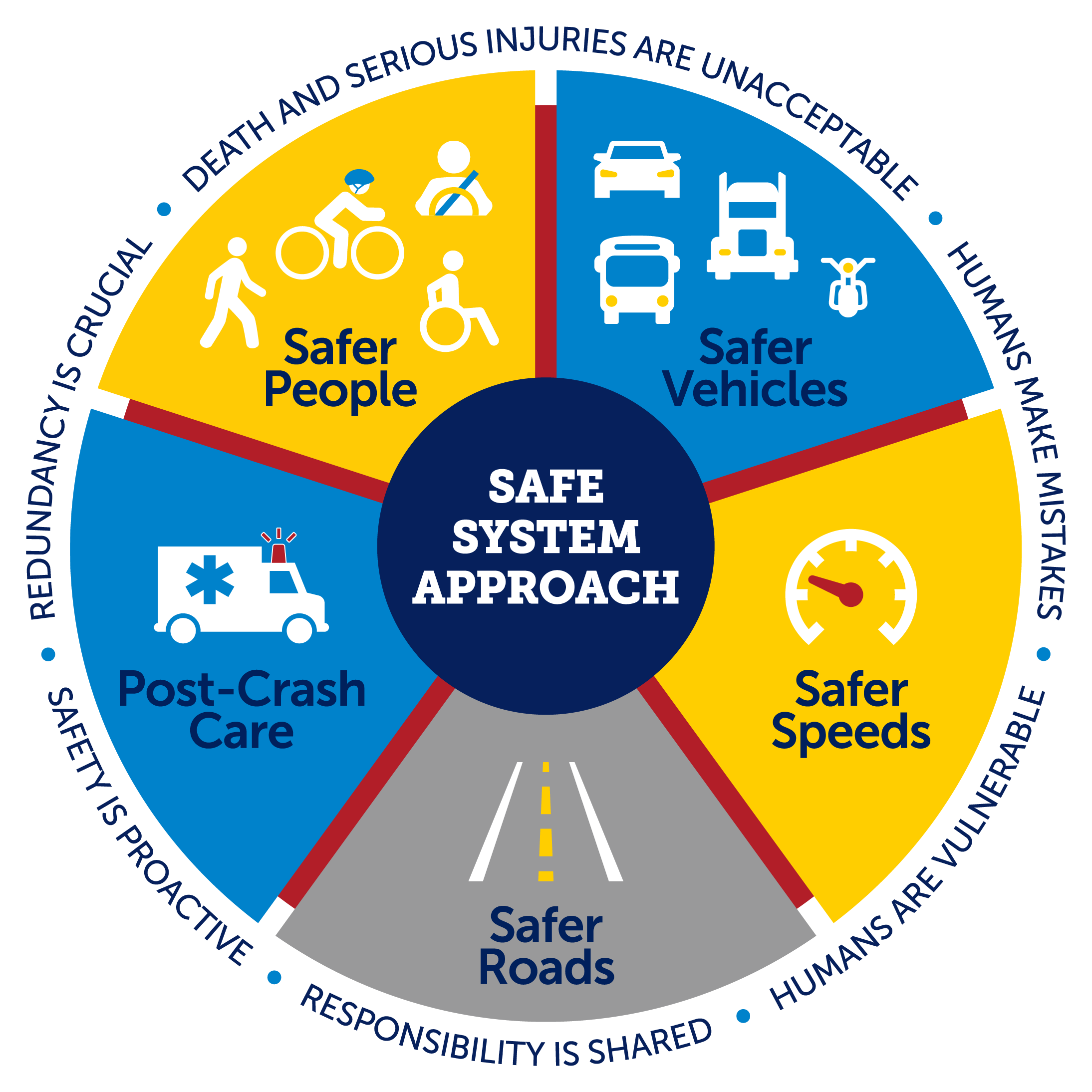
First adopted in the 1990s in Sweden, this philosophy was embraced by the U.S. Department of Transportation in 2022. It focuses on making every trip as safe as possible for the individual traveler, with the knowledge that humans make mistakes but should not have to die because of them. In the safe system, responsibility for ensuring safety is shared by all users and owners of the transportation system. Redundancy is essential: If one part of the system fails, there are backstops to limit the damage. Graphic: U.S. Department of Transportation
A safe transportation system has five main components:
- Safe road users — encouraging safe behavior by drivers, passengers, pedestrians, motorcyclists, bicyclists, etc.
- Safe vehicles — ensuring that vehicle designs incorporate features that help drivers avoid crashing and that reduce the risk and severity of both occupant and nonoccupant injuries when crashes occur.
- Safe roads — designing roads to help drivers avoid crashing, provide safe passage for vulnerable road users and mitigate the consequences of crashes that do occur.
- Safe speeds — encouraging appropriate speeds based on the understanding that people make mistakes and are vulnerable to injury.
- Post-crash care — enhancing the survivability of crashes through fast access to emergency medical care, while creating a safe working environment for first responders and preventing secondary crashes.
Our focus areas
While there are many possible paths to 30x30, the IIHS-HLDI contribution will consist of actions under three broad areas — reducing risky behavior, accelerating commercial vehicle safety and extending safety to everyone, both inside and outside vehicles. Below we explain why these areas are important, and on the following pages we outline specific goals under each of them.
Focus area 1
Reducing risky behavior
Risky behavior, such as alcohol impairment, speeding, distraction and failure to use seat belts, is a chief contributor to our road safety problem. In 2022, 13,524 people died in crashes involving at least one alcohol-impaired driver. That same year, police reported 3,308 distracted driving fatalities, though the actual number could be nearly 4 times as high, according to one government estimate. Twenty-nine percent of fatalities (12,151 deaths) occurred in crashes involving speeding. And despite relatively high observed use of seat belts (92% for drivers and 90% for front-seat passengers), failure to buckle up played an outsize role in fatalities. Only 45% of passenger vehicle drivers and 51% of front seat passengers killed in 2022 were confirmed to be using belts. Only 26% of fatally injured back seat occupants ages 13 and older were belted.
Focus area 2
Accelerating commercial vehicle safety
In 2022, 5,502 lives were lost in crashes involving large trucks or light vans; in most cases, it was other road users, not the drivers of the trucks and vans, who were killed. Currently, federal regulations do not require crash avoidance systems or impose crashworthiness standards on commercial motor vehicles. The decision to purchase optional crash avoidance systems or aftermarket safety equipment is left to fleet managers and individual independent operators with input from commercial insurers who assist them in managing operational risks. We can help inform these decision-makers. Historically, commercial vehicle safety has been a minor part of the Institutes’ work, and we have been successful in improving some aspects of safety, such as by encouraging the adoption of stronger rear underride guards. With the continued growth of online retail, heavy-goods transport and last-mile delivery services will continue to grow. This area presents opportunities to have a large impact by leveraging our expertise and experience in the passenger vehicle market.
Focus area 3
Extending safety to everyone
The victims of motor vehicle crashes include all types of people using all modes of transportation, including walking, riding and driving. A total of 7,522 pedestrians, 6,222 motorcyclists and 1,084 bicyclists were killed in 2022, representing more than a third of all the lives lost to crashes that year. The 49% increase in fatalities among these vulnerable road users from 2014 to 2022 was even steeper than the 30% increase in total traffic fatalities over those years. Meanwhile, vehicle occupants vary widely in their risk of injury due to variations in age, sex, size and economic resources. Vehicle testing, road design and transportation policy must take into account the safety of all road users.
How we developed our goals
As stated above, this strategic plan envisions a 30% reduction in road deaths by 2030, which would put the country back on a course toward zero deaths. Specific goals under each of the three broad focus areas were developed using the philosophy of a Safe System. To achieve them, we will leverage partnerships with other research institutions, industry allies, advocates and public agencies. We will also expand our resources for problem identification and intervention development while continuing to influence decision-makers to pave the way for a safer future. Recognizing that IIHS-HLDI does not have the power to bring down fatalities on our own, our goals identify actions that are within our control.
The five-year time frame of this strategic plan is divided into three spans: 2025-26, 2027-28 and 2029 (and beyond). For each goal, we indicate in which span we intend to initiate work and deliver on the goal. For most goals achieved before the end of the five years, we will maintain and expand on the work in question.
The Institutes are already well-positioned to achieve these goals with strong support from our member companies; solid research, communications and marketing capabilities, supported by an experienced, qualified staff; and tangible assets such as HLDI’s robust databases of insurance claims and vehicle features and the Vehicle Research Center’s state-of-the-art labs and equipment and extensive tracks. We intend to strengthen our capabilities over the coming years and have outlined our specific strategies to do so under the heading of organizational excellence. At the same time, we will avoid duplicating the work of other safety groups and will instead look for ways to collaborate with other actors in this space so that we complement and amplify each other’s work.
We have formulated this road map based on the information available to us today, at the end of 2024. But this is a living document. As we work through the goals we have laid out, we will no doubt gain new perspective on which actions will be most impactful. Developments in the road safety situation and steps taken by other stakeholders could also prompt us to adjust course. For these reasons, we intend to revisit these goals periodically and fine-tune them as necessary.
Tracking our progress
We will report yearly on our progress toward our goals, each of which has a specific deliverable such as an action plan, assessment report, analytical tool, safety benefit calculator, partnership strategy, demonstration project, communications product or rating program. We will track our percent-complete progress for these deliverables.
We will also regularly assess the impact that our efforts are having toward achieving the 30x30 vision. We will track total fatalities as well as fatalities associated with our areas of emphasis. For risky behaviors, we will track deaths associated with speed, impairment, distraction and restraint use. For commercial vehicles, we will track fatal crash involvements and types of collisions. For safety for everyone, we will track deaths of pedestrians, bicyclists and motorcyclists as well as the demographics of occupant deaths. Monitoring these metrics will allow us to determine where we are making progress and where we may need to focus more resources.