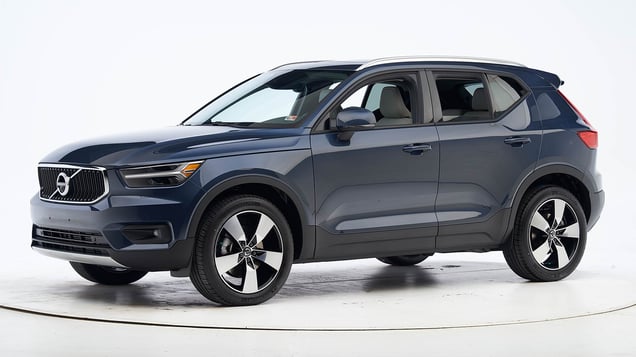
2025 Volvo XC40
small SUV / 4-door SUV
Small overlap front
The small overlap front evaluation consists of a driver-side and a passenger-side component. If the results of the two evaluations differ, then the combined small overlap rating is equal to the lower rating.
Driver-side
Tested vehicle: 2019 Volvo XC40 T5 Momentum 4-door 4wd
Rating applies to 2019-26 models
The Volvo XC40 was introduced in the 2019 model year.
| Evaluation criteria | Rating |
|---|---|
| Overall driver-side evaluation | |
| Structure and safety cage | |
| Driver injury measures | |
| Head/neck | |
| Chest | |
| Hip/thigh | |
| Lower leg/foot | |
| Driver restraints and dummy kinematics | |
Technical measurements for this test
Measures of occupant compartment intrusion on driver side
| Evaluation criteria | Measurement |
|---|---|
| Test ID | CEN1810 |
| Lower occupant compartment | |
| Lower hinge pillar max (cm) | 4 |
| Footrest (cm) | 2 |
| Left toepan (cm) | 1 |
| Brake pedal (cm) | 4 |
| Parking brake (cm) | |
| Rocker panel lateral average (cm) | 1 |
| Upper occupant compartment | |
| Steering column | 0 |
| Upper hinge pillar max (cm) | 3 |
| Upper dash (cm) | 3 |
| Lower instrument panel (cm) | 2 |
Driver injury measures
| Evaluation criteria | Measurement |
|---|---|
| Test ID | CEN1810 |
| Head | |
| HIC-15 | 100 |
| Peak gs at hard contact | no contact |
| Neck | |
| Tension (kN) | 1.0 |
| Extension bending moment (Nm) | 16 |
| Maximum Nij | 0.23 |
| Chest maximum compression (mm) | 16 |
| Femur (kN) | |
| Left | 0.9 |
| Right | 0.7 |
| Knee displacement (mm) | |
| Left | 0 |
| Right | 1 |
| Knee-thigh-hip injury risk (%) | |
| Left | 0 |
| Right | 0 |
| Maximum tibia index | |
| Left | 0.60 |
| Right | 0.43 |
| Tibia axial force (kN) | |
| Left | 2.6 |
| Right | 1.4 |
| Foot acceleration (g) | |
| Left | 55 |
| Right | 43 |
Passenger-side
Tested vehicle: 2019 Volvo XC40 T5 4-door 4wd
Rating applies to 2019-26 models
The Volvo XC40 was introduced in the 2019 model. Passenger-side small overlap frontal ratings are assigned by the Institute based on a test conducted by Volvo.
| Evaluation criteria | Rating |
|---|---|
| Overall passenger-side evaluation | |
| Structure and safety cage | |
| Passenger injury measures | |
| Head/neck | |
| Chest | |
| Hip/thigh | |
| Lower leg/foot | |
| Passenger restraints and dummy kinematics | |
| Driver injury measures | |
| Head/neck | |
| Chest | |
| Hip/thigh | |
| Lower leg/foot | |
| Driver restraints and dummy kinematics | |
Technical measurements for this test
Measures of occupant compartment intrusion on passenger side
| Evaluation criteria | Measurement |
|---|---|
| Test ID | VTP1901 |
| Lower occupant compartment | |
| Lower hinge pillar max (cm) | 16 |
| Footrest (cm) | 9 |
| Right toepan (cm) | 4 |
| Center toepan (cm) | 3 |
| Rocker panel lateral average (cm) | 8 |
| Upper occupant compartment | |
| Center dash (cm) | 3 |
| Upper hinge pillar max (cm) | 7 |
| Upper dash (cm) | 4 |
| Right lower dash (cm) | 4 |
Passenger injury measures
| Evaluation criteria | Measurement |
|---|---|
| Test ID | VTP1901 |
| Head | |
| HIC-15 | 136 |
| Peak gs at hard contact | no contact |
| Neck | |
| Tension (kN) | 0.7 |
| Extension bending moment (Nm) | 9 |
| Maximum Nij | 0.15 |
| Chest maximum compression (mm) | 24 |
| Femur (kN) | |
| Left | 2.0 |
| Right | 6.6 |
| Knee displacement (mm) | |
| Left | 0 |
| Right | 1 |
| Knee-thigh-hip injury risk (%) | |
| Left | 0 |
| Right | 6 |
| Maximum tibia index | |
| Left | 0.33 |
| Right | 0.52 |
| Tibia axial force (kN) | |
| Left | 1.0 |
| Right | 1.4 |
| Foot acceleration (g) | |
| Left | 27 |
| Right | 43 |
Driver injury measures
| Evaluation criteria | Measurement |
|---|---|
| Test ID | VTP1901 |
| Head | |
| HIC-15 | 98 |
| Peak gs at hard contact | no contact |
| Neck | |
| Tension (kN) | 1.1 |
| Extension bending moment (Nm) | 5 |
| Maximum Nij | 0.20 |
| Chest maximum compression (mm) | 27 |
| Femur (kN) | |
| Left | 0.4 |
| Right | 0.2 |
| Knee displacement (mm) | |
| Left | 1 |
| Right | 1 |
| Knee-thigh-hip injury risk (%) | |
| Left | 0 |
| Right | 0 |
| Maximum tibia index | |
| Left | 0.33 |
| Right | 0.19 |
| Tibia axial force (kN) | |
| Left | 0.4 |
| Right | 0.3 |
| Foot acceleration (g) | |
| Left | 30 |
| Right | 51 |
Moderate overlap front: updated test
Tested vehicle: 2021 Volvo XC40 T5 Momentum 4-door 4wd
Rating applies to 2021-26 models
The Volvo XC40 was introduced in the 2019 model year.
| Evaluation criteria | Rating |
|---|---|
| Overall evaluation | |
| Structure and safety cage | |
| Driver injury measures | |
| Head/neck | |
| Chest | |
| Thigh/hip | |
| Leg/foot | |
| Driver restraints and dummy kinematics | |
| Rear passenger injury measures | |
| Head/neck | |
| Chest | |
| Thigh | |
| Rear passenger restraints and dummy kinematics | |
Technical measurements for this test
Measures of occupant compartment intrusion on driver side
| Evaluation criteria | Measurement |
|---|---|
| Test ID | CEF2108 |
| Footwell intrusion | |
| Footrest (cm) | 4 |
| Left (cm) | 6 |
| Center (cm) | 3 |
| Right (cm) | 2 |
| Brake pedal (cm) | 4 |
| Instrument panel rearward movement | |
| Left (cm) | 0 |
| Right (cm) | 0 |
| Steering column movement | |
| Upward (cm) | 1 |
| Rearward (cm) | -2 |
| A-pillar rearward movement (cm) | 0 |
Driver injury measures
| Evaluation criteria | Measurement |
|---|---|
| Test ID | CEF2108 |
| Head | |
| HIC-15 | 244 |
| Peak gs at hard contact | no contact |
| Neck | |
| Tension (kN) | 1.2 |
| Extension bending moment (Nm) | 14 |
| Maximum Nij | 0.25 |
| Chest maximum compression (mm) | 26 |
| Femur (kN) | |
| Left | 0.5 |
| Right | 0.4 |
| Knee displacement (mm) | |
| Left | 0 |
| Right | 0 |
| Knee-thigh-hip injury risk (%) | |
| Left | 0 |
| Right | 0 |
| Maximum tibia index | |
| Left | 0.16 |
| Right | 0.22 |
| Tibia axial force (kN) | |
| Left | 1.8 |
| Right | 1.8 |
| Foot acceleration (g) | |
| Left | 44 |
| Right | 63 |
Rear passenger injury measures
| Test ID | CEF2108 |
|---|---|
| Head | |
| HIC-15 for head contact during forward excursion | no contact |
| Peak gs at hard contact | no contact |
| Neck | |
| Tension (kN) | 1.8 |
| Compression (kN) | 0.4 |
| Maximum Nij for head contact during forward excursion | no contact |
| Chest | |
| Chest index | 34 |
| Shoulder belt tension (kN) | 5.5 |
| Thigh (kN) | |
| Left femur compression | 0.3 |
| Right femur compression | 0.4 |
Side: updated test
Tested vehicle: 2021 Volvo XC40 T5 Momentum 4-door 4wd
Rating applies to 2019-26 models
The Volvo XC40 was introduced in the 2019 model year.
| Evaluation criteria | Rating |
|---|---|
| Overall evaluation | |
| Structure and safety cage | |
| Driver injury measures | |
| Head/neck | |
| Torso | |
| Pelvis | |
| Driver head protection | |
| Rear passenger injury measures | |
| Head/neck | |
| Torso | |
| Pelvis | |
| Rear passenger head protection | |
Technical measurements for this test
Measures of occupant compartment intrusion on driver side
| Evaluation criteria | Measurement |
|---|---|
| Test ID | CES2006 |
| B-pillar to longitudinal centerline of driver's seat (cm) | -12.0 |
| Negative numbers indicate the amount by which the crush stopped short of the seat centerline. | |
Driver injury measures
| Evaluation criteria | Measurement |
|---|---|
| Test ID | CES2006 |
| Head | |
| HIC-15 | 129 |
| Peak gs at hard contact | no contact |
| Neck | |
| Tension (kN) | 1.4 |
| Compression (kN) | 0.2 |
| Shoulder | |
| Lateral deflection (mm) | 37 |
| Lateral force (kN) | 1.3 |
| Torso | |
| Maximum deflection (mm) | 42 |
| Average deflection (mm) | 37 |
| Maximum deflection rate (m/s) | 4.03 |
| Maximum viscous criterion (m/s) | 0.84 |
| Pelvis | |
| Combined force (kN) | 5.3 |
Passenger injury measures
| Evaluation criteria | Measurement |
|---|---|
| Test ID | CES2006 |
| Head | |
| HIC-15 | 387 |
| Peak gs at hard contact | no contact |
| Neck | |
| Tension (kN) | 1.2 |
| Compression (kN) | 0.4 |
| Shoulder | |
| Lateral deflection (mm) | 28 |
| Lateral force (kN) | 1.3 |
| Torso | |
| Maximum deflection (mm) | 38 |
| Average deflection (mm) | 31 |
| Maximum deflection rate (m/s) | 4.59 |
| Maximum viscous criterion (m/s) | 0.65 |
| Pelvis | |
| Combined force (kN) | 3.1 |
Whiplash prevention
Tested seat type: Power synthetic leather seat
Rating applies to 2025-26 models
| Evaluation criteria | Rating | |
|---|---|---|
| Overall evaluation |
Technical measurements for this test
16 km/h load case (simulated 32 km/h impact)
| Injury metric | Demerits | |
|---|---|---|
| Group 1: Head and spine support | ||
| Head-pelvis relative velocity | 3.2 | 1 |
| Head contact time | 63 | |
| Group 2: Upper neck load and moment management | ||
| Max Nkm | 0.25 | 0 |
| Upper neck tension | 449 | |
| Group 3: Management of energy transferred to the occupant | ||
| T1 X maximum acceleration | 13.2 | 2 |
| Pelvis displacement (min) | -137 | |
| Total | 3 | |
24 km/h load case (simulated 48 km/h impact)
| Injury metric | Demerits | |
|---|---|---|
| Group 1: Head and spine support | ||
| Head-pelvis relative velocity | 4.4 | 1 |
| Head contact time | 63 | |
| Group 2: Upper neck load and moment management | ||
| Max Nkm | 0.32 | 0 |
| Upper neck tension | 411 | |
| Group 3: Management of energy transferred to the occupant | ||
| T1 X maximum acceleration | 15.6 | 2 |
| Pelvis displacement (min) | -184 | |
| Total | 3 | |
| Total demerits | 6 | |
|---|---|---|
Front crash prevention: pedestrian (day)
Seat belt reminders
Rating applies to 2023-26 models
| Evaluation criteria | Rating |
|---|---|
| Overall evaluation | |
| Front row | |
| Unbelted occupant alert (audible & visual) | |
| Initiation time | Yes |
| Duration | Long enough (90+ seconds) |
| Volume | Yes |
| Audio frequency | Yes |
| Second row | |
| Startup status alert (visual) | |
| Initiation time | Yes |
| Duration at least 60 seconds | Yes |
| Belt disengaged alert (audible & visual) | |
| Initiation time | Yes |
| Duration at least 30 seconds | Yes |
| Volume | Yes |
| Audio frequency | Yes |
Technical measurements for this test
| Evaluation criteria | Measurement |
|---|---|
| Background cabin sound pressure level at 24 km/h | 51 dB |
| Audible signal sound pressure level at 24 km/h | 60 dB |
| Difference between background and signal | 8.8 dB |
| Background cabin sound pressure level at 40 km/h | 55 dB |
| Audible signal sound pressure level at 40 km/h | 62 dB |
| Difference between background and signal | 6.3 dB |
| Dominant audio frequency | 528 Hz |