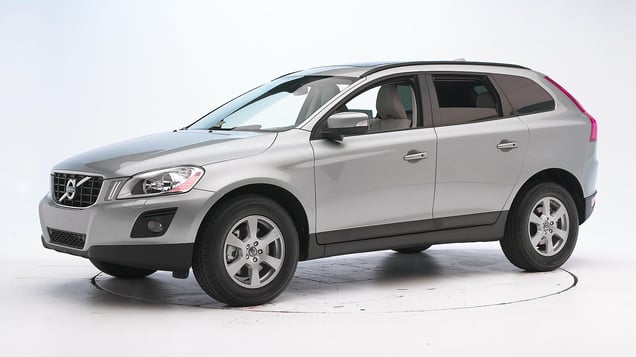
Moderate overlap front: original test
Tested vehicle: 2010 Volvo XC60 3.2 4-door 4wd
Rating applies to 2010-17 models
The Volvo XC60 was introduced in the 2010 model year.
| Evaluation criteria | Rating |
|---|---|
| Overall evaluation | |
| Structure and safety cage | |
| Driver injury measures | |
| Head/neck | |
| Chest | |
| Leg/foot, left | |
| Leg/foot, right | |
| Driver restraints and dummy kinematics | |
Technical measurements for this test
Measures of occupant compartment intrusion on driver side
| Evaluation criteria | Measurement |
|---|---|
| Test ID | CEF0916 |
| Footwell intrusion | |
| Footrest (cm) | 3 |
| Left (cm) | 4 |
| Center (cm) | 4 |
| Right (cm) | 7 |
| Brake pedal (cm) | 3 |
| Instrument panel rearward movement | |
| Left (cm) | 1 |
| Right (cm) | 1 |
| Steering column movement | |
| Upward (cm) | -1 |
| Rearward (cm) | -6 |
| A-pillar rearward movement (cm) | 0 |
Driver injury measures
| Evaluation criteria | Measurement |
|---|---|
| Test ID | CEF0916 |
| Head | |
| HIC-15 | 188 |
| Peak gs at hard contact | 11 |
| Neck | |
| Tension (kN) | 1.0 |
| Extension bending moment (Nm) | 4 |
| Maximum Nij | 0.19 |
| Chest maximum compression (mm) | 39 |
| Legs | |
| Femur force - left (kN) | 2.1 |
| Femur force - right (kN) | 0.7 |
| Knee displacement - left (mm) | 1 |
| Knee displacement - right (mm) | 0 |
| Maximum tibia index - left | 0.26 |
| Maximum tibia index - right | 0.68 |
| Tibia axial force - left (kN) | 1.2 |
| Tibia axial force - right (kN) | 2.8 |
| Foot acceleration (g) | |
| Left | 44 |
| Right | 62 |
Side: original test
Tested vehicle: 2010 Volvo XC60 3.2 4-door 4wd with standard front and rear head curtain airbags and standard front seat-mounted torso airbags
Rating applies to 2010-17 models
The Volvo XC60 was introduced in the 2010 model year.
During the test, the lower side seat trim was pushed against a service release button for the safety belt, which then detached from its anchor on the outboard side of the driver's seat. Although there was no unusual movement of the dummy, the dummy was not restrained during part of the crash event. Volvo has addressed the problem on models built after November 2009 and is issuing a recall to fix the belts on cars built earlier.
Cars built before the fix and subsequently not repaired would be rated only Acceptable and would not be eligible for TOP SAFETY PICK status.
| Evaluation criteria | Rating |
|---|---|
| Overall evaluation | |
| Structure and safety cage | |
| Driver injury measures | |
| Head/neck | |
| Torso | |
| Pelvis/leg | |
| Driver head protection | |
| Rear passenger injury measures | |
| Head/neck | |
| Torso | |
| Pelvis/leg | |
| Rear passenger head protection | |
Technical measurements for this test
Measures of occupant compartment intrusion on driver side
| Test ID | CES0927 |
|---|---|
| B-pillar to longitudinal centerline of driver's seat (cm) | -22.0 |
| Negative numbers indicate the amount by which the crush stopped short of the seat centerline. | |
Driver injury measures
| Evaluation criteria | Measurement |
|---|---|
| Test ID | CES0927 |
| Head HIC-15 | 85 |
| Neck | |
| Tension (kN) | 0.7 |
| Compression (kN) | 0.3 |
| Shoulder | |
| Lateral deflection (mm) | 30 |
| Lateral force (kN) | 1.2 |
| Torso | |
| Maximum deflection (mm) | 32 |
| Average deflection (mm) | 25 |
| Maximum deflection rate (m/s) | 3.37 |
| Maximum viscous criterion (m/s) | 0.48 |
| Pelvis | |
| Iliac force (kN) | 1.0 |
| Acetabulum force (kN) | 0.9 |
| Combined force (kN) | 1.8 |
| Left femur | |
| L-M force (kN) | 0.5 |
| L-M moment (Nm) | 33 |
| A-P moment (Nm) | -19 |
Passenger injury measures
| Evaluation criteria | Measurement |
|---|---|
| Test ID | CES0927 |
| Head HIC-15 | 158 |
| Neck | |
| Tension (kN) | 0.2 |
| Compression (kN) | 0.4 |
| Shoulder | |
| Lateral deflection (mm) | 37 |
| Lateral force (kN) | 1.5 |
| Torso | |
| Maximum deflection (mm) | 26 |
| Average deflection (mm) | 21 |
| Maximum deflection rate (m/s) | 2.66 |
| Maximum viscous criterion (m/s) | 0.25 |
| Pelvis | |
| Iliac force (kN) | 0.5 |
| Acetabulum force (kN) | 2.6 |
| Combined force (kN) | 3.0 |
| Left femur | |
| L-M force (kN) | 0.3 |
| L-M moment (Nm) | 56 |
| A-P moment (Nm) | -20 |
Roof strength
Tested vehicle: 2010 Volvo XC60 3.2 4-door 4wd
Rating applies to 2010-17 models
| Overall evaluation | |
|---|---|
| Curb weight | 4,172 lbs |
| Peak force | 21,828 lbs |
| Strength-to-weight ratio | 5.23 |
Head restraints & seats
Seat type: All seats
| Overall evaluation | |
|---|---|
| Dynamic rating | |
| Seat/head restraint geometry |
Technical measurements for this test
| Seat type | All seats |
|---|---|
| Geometry | |
| Backset (mm) | 34 |
| Distance below top of head (mm) | 6 |
| Seat design parameters | |
| Pass/fail | Pass |
| Max T1 acceleration (g) | 8.2 |
| Head contact time (ms) | 84 |
| Force rating | 1 |
| Neck forces | |
| Max neck shear force (N) | 20 |
| Max neck tension (N) | 328 |
About the head restraint & seat test
Currently, IIHS tests apply only to front seats.