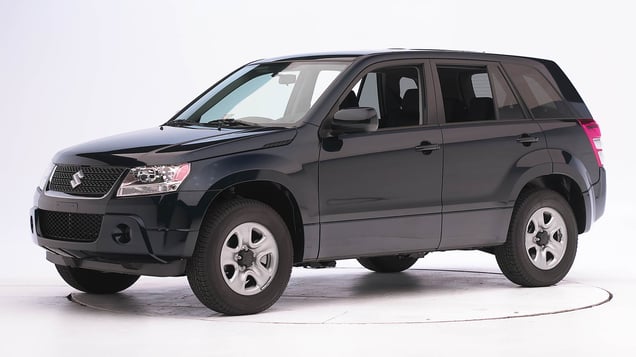
2010 Suzuki Grand Vitara
small SUV / 4-door SUV
Moderate overlap front: original test
Tested vehicle: 2008 Suzuki Grand Vitara 4-door 4wd
Rating applies to 2006-13 models
The Suzuki Grand Vitara was redesigned for the 2006 model year and discontinued after the 2013 model year.
| Evaluation criteria | Rating |
|---|---|
| Overall evaluation | |
| Structure and safety cage | |
| Driver injury measures | |
| Head/neck | |
| Chest | |
| Leg/foot, left | |
| Leg/foot, right | |
| Driver restraints and dummy kinematics | |
Technical measurements for this test
Measures of occupant compartment intrusion on driver side
| Evaluation criteria | Measurement |
|---|---|
| Test ID | CEF0810 |
| Footwell intrusion | |
| Footrest (cm) | 12 |
| Left (cm) | 15 |
| Center (cm) | 17 |
| Right (cm) | 9 |
| Brake pedal (cm) | 18 |
| Instrument panel rearward movement | |
| Left (cm) | 3 |
| Right (cm) | 2 |
| Steering column movement | |
| Upward (cm) | 8 |
| Rearward (cm) | 4 |
| A-pillar rearward movement (cm) | 3 |
Driver injury measures
| Evaluation criteria | Measurement |
|---|---|
| Test ID | CEF0810 |
| Head | |
| HIC-15 | 358 |
| Peak gs at hard contact | no contact |
| Neck | |
| Tension (kN) | 1.4 |
| Extension bending moment (Nm) | 17 |
| Maximum Nij | 0.33 |
| Chest maximum compression (mm) | 32 |
| Legs | |
| Femur force - left (kN) | 3.8 |
| Femur force - right (kN) | 3.2 |
| Knee displacement - left (mm) | 0 |
| Knee displacement - right (mm) | 3 |
| Maximum tibia index - left | 0.19 |
| Maximum tibia index - right | 0.34 |
| Tibia axial force - left (kN) | 1.4 |
| Tibia axial force - right (kN) | 2.5 |
| Foot acceleration (g) | |
| Left | 58 |
| Right | 63 |
Side: original test
Tested vehicle: 2008 Suzuki Grand Vitara 4-door 4wd with standard front and rear head curtain airbags and standard front seat-mounted side torso airbags
Rating applies to 2006-13 models
The Suzuki Grand Vitara was redesigned for the 2006 model year and discontinued after the 2013 model year.
| Evaluation criteria | Rating |
|---|---|
| Overall evaluation | |
| Structure and safety cage | |
| Driver injury measures | |
| Head/neck | |
| Torso | |
| Pelvis/leg | |
| Driver head protection | |
| Rear passenger injury measures | |
| Head/neck | |
| Torso | |
| Pelvis/leg | |
| Rear passenger head protection | |
Technical measurements for this test
Measures of occupant compartment intrusion on driver side
| Test ID | CES0827 |
|---|---|
| B-pillar to longitudinal centerline of driver's seat (cm) | -8.5 |
| Negative numbers indicate the amount by which the crush stopped short of the seat centerline. | |
Driver injury measures
| Evaluation criteria | Measurement |
|---|---|
| Test ID | CES0827 |
| Head HIC-15 | 191 |
| Neck | |
| Tension (kN) | 0.9 |
| Compression (kN) | 0.1 |
| Shoulder | |
| Lateral deflection (mm) | 38 |
| Lateral force (kN) | 1.8 |
| Torso | |
| Maximum deflection (mm) | 35 |
| Average deflection (mm) | 26 |
| Maximum deflection rate (m/s) | 3.77 |
| Maximum viscous criterion (m/s) | 0.65 |
| Pelvis | |
| Iliac force (kN) | 4.8 |
| Acetabulum force (kN) | 1.9 |
| Combined force (kN) | 6.6 |
| Left femur | |
| L-M force (kN) | 0.2 |
| L-M moment (Nm) | 80 |
| A-P moment (Nm) | -33 |
Passenger injury measures
| Evaluation criteria | Measurement |
|---|---|
| Test ID | CES0827 |
| Head HIC-15 | 173 |
| Neck | |
| Tension (kN) | 0.0 |
| Compression (kN) | 0.6 |
| Shoulder | |
| Lateral deflection (mm) | 26 |
| Lateral force (kN) | 1.3 |
| Torso | |
| Maximum deflection (mm) | 19 |
| Average deflection (mm) | 14 |
| Maximum deflection rate (m/s) | 1.94 |
| Maximum viscous criterion (m/s) | 0.15 |
| Pelvis | |
| Iliac force (kN) | 2.1 |
| Acetabulum force (kN) | 1.5 |
| Combined force (kN) | 3.4 |
| Left femur | |
| L-M force (kN) | 0.5 |
| L-M moment (Nm) | 83 |
| A-P moment (Nm) | -42 |
Roof strength
Tested vehicle: 2009 Suzuki Grand Vitara Premium 4-door 4wd
Rating applies to 2009-13 models
| Overall evaluation | |
|---|---|
| Curb weight | 3,639 lbs |
| Peak force | 12,727 lbs |
| Strength-to-weight ratio | 3.50 |
Head restraints & seats
Seat type: All seats
| Overall evaluation | |
|---|---|
| Dynamic rating | |
| Seat/head restraint geometry |
Technical measurements for this test
| Seat type | All seats |
|---|---|
| Geometry | |
| Backset (mm) | 40 |
| Distance below top of head (mm) | 40 |
| Seat design parameters | |
| Pass/fail | Fail |
| Max T1 acceleration (g) | 13.6 |
| Head contact time (ms) | 79 |
| Force rating | 2 |
| Neck forces | |
| Max neck shear force (N) | 63 |
| Max neck tension (N) | 773 |
About the head restraint & seat test
Currently, IIHS tests apply only to front seats.