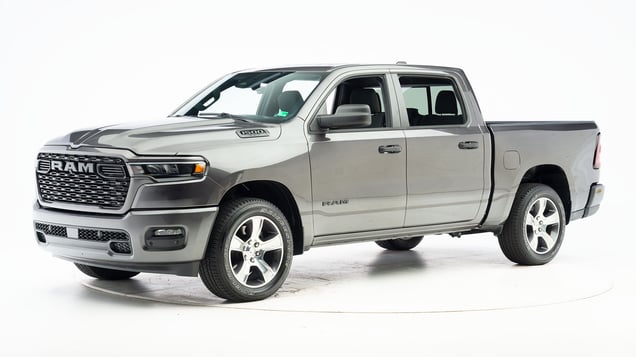
2026 Ram 1500
large pickup / Crew cab pickup
Small overlap front
The small overlap front evaluation consists of a driver-side and a passenger-side component. If the results of the two evaluations differ, then the combined small overlap rating is equal to the lower rating.
Driver-side
Tested vehicle: 2025 Ram 1500 Big Horn Crew cab 4wd
Rating applies to 2025-27 models
The Ram 1500 Crew Cab was redesigned for the 2019 model year. Beginning with 2025 models, changes were made to the steering column and driver-side airbag to improve occupant safety in driver-side small overlap crashes. Ratings are based on a test of a 2025 Ram 1500 conducted by Stellantis.
| Evaluation criteria | Rating |
|---|---|
| Overall driver-side evaluation | |
| Structure and safety cage | |
| Driver injury measures | |
| Head/neck | |
| Chest | |
| Hip/thigh | |
| Lower leg/foot | |
| Driver restraints and dummy kinematics | |
Technical measurements for this test
Measures of occupant compartment intrusion on driver side
| Evaluation criteria | Measurement |
|---|---|
| Test ID | VTN2515 |
| Lower occupant compartment | |
| Lower hinge pillar max (cm) | 10 |
| Footrest (cm) | 11 |
| Left toepan (cm) | 11 |
| Brake pedal (cm) | 13 |
| Parking brake (cm) | |
| Rocker panel lateral average (cm) | 0 |
| Upper occupant compartment | |
| Steering column | 0 |
| Upper hinge pillar max (cm) | 10 |
| Upper dash (cm) | 10 |
| Lower instrument panel (cm) | 9 |
Driver injury measures
| Evaluation criteria | Measurement |
|---|---|
| Test ID | VTN2515 |
| Head | |
| HIC-15 | 123 |
| Peak gs at hard contact | no contact |
| Neck | |
| Tension (kN) | 0.7 |
| Extension bending moment (Nm) | 8 |
| Maximum Nij | 0.22 |
| Chest maximum compression (mm) | 22 |
| Femur (kN) | |
| Left | 1.0 |
| Right | 0.2 |
| Knee displacement (mm) | |
| Left | 5 |
| Right | 1 |
| Knee-thigh-hip injury risk (%) | |
| Left | 0 |
| Right | 0 |
| Maximum tibia index | |
| Left | 0.54 |
| Right | 0.35 |
| Tibia axial force (kN) | |
| Left | 3.4 |
| Right | 1.1 |
| Foot acceleration (g) | |
| Left | 93 |
| Right | 49 |
Passenger-side
Tested vehicle: 2025 RAM 1500 Big Horn Crew cab 4wd
Rating applies to 2025-27 models
The Ram 1500 Crew Cab was redesigned for the 2019 model year. Beginning with 2025 models, changes were made to the passenger-side airbag to improve occupant safety in passenger-side small overlap crashes. Ratings are based on a test of a 2025 Ram 1500 conducted by Stellantis.
| Evaluation criteria | Rating |
|---|---|
| Overall passenger-side evaluation | |
| Structure and safety cage | |
| Passenger injury measures | |
| Head/neck | |
| Chest | |
| Hip/thigh | |
| Lower leg/foot | |
| Passenger restraints and dummy kinematics | |
| Driver injury measures | |
| Head/neck | |
| Chest | |
| Hip/thigh | |
| Lower leg/foot | |
| Driver restraints and dummy kinematics | |
Technical measurements for this test
Measures of occupant compartment intrusion on passenger side
| Evaluation criteria | Measurement |
|---|---|
| Test ID | VTP2517 |
| Lower occupant compartment | |
| Lower hinge pillar max (cm) | 10 |
| Footrest (cm) | 19 |
| Right toepan (cm) | 14 |
| Center toepan (cm) | 6 |
| Rocker panel lateral average (cm) | 5 |
| Upper occupant compartment | |
| Center dash (cm) | 7 |
| Upper hinge pillar max (cm) | 10 |
| Upper dash (cm) | 10 |
| Right lower dash (cm) | 10 |
Passenger injury measures
| Evaluation criteria | Measurement |
|---|---|
| Test ID | VTP2517 |
| Head | |
| HIC-15 | 284 |
| Peak gs at hard contact | no contact |
| Neck | |
| Tension (kN) | 1.0 |
| Extension bending moment (Nm) | 23 |
| Maximum Nij | 0.20 |
| Chest maximum compression (mm) | 15 |
| Femur (kN) | |
| Left | 1.6 |
| Right | 1.4 |
| Knee displacement (mm) | |
| Left | 8 |
| Right | 5 |
| Knee-thigh-hip injury risk (%) | |
| Left | 0 |
| Right | 0 |
| Maximum tibia index | |
| Left | 0.59 |
| Right | 0.91 |
| Tibia axial force (kN) | |
| Left | 2.8 |
| Right | 2.6 |
| Foot acceleration (g) | |
| Left | 106 |
| Right | 79 |
Driver injury measures
| Evaluation criteria | Measurement |
|---|---|
| Test ID | VTP2517 |
| Head | |
| HIC-15 | 87 |
| Peak gs at hard contact | no contact |
| Neck | |
| Tension (kN) | 1.1 |
| Extension bending moment (Nm) | 11 |
| Maximum Nij | 0.20 |
| Chest maximum compression (mm) | 15 |
| Femur (kN) | |
| Left | 0.0 |
| Right | 0.0 |
| Knee displacement (mm) | |
| Left | 1 |
| Right | 0 |
| Knee-thigh-hip injury risk (%) | |
| Left | 0 |
| Right | 0 |
| Maximum tibia index | |
| Left | 0.48 |
| Right | 0.23 |
| Tibia axial force (kN) | |
| Left | 0.1 |
| Right | 0.9 |
| Foot acceleration (g) | |
| Left | 80 |
| Right | 52 |
Moderate overlap front: updated test
Tested vehicle: 2025 Ram 1500 Tradesman Crew Cab 4-door 4wd
Rating applies to 2025-27 models
The Ram 1500 Crew Cab was redesigned for the 2019 model year. Beginning with 2025 models, pretensioners and load limiters were added to the rear passenger outboard seats.
| Evaluation criteria | Rating |
|---|---|
| Overall evaluation | |
| Structure and safety cage | |
| Driver injury measures | |
| Head/neck | |
| Chest | |
| Thigh/hip | |
| Leg/foot | |
| Driver restraints and dummy kinematics | |
| Rear passenger injury measures | |
| Head/neck | |
| Chest | |
| Thigh | |
|
Rear passenger restraints and dummy kinematics
| |
Technical measurements for this test
Measures of occupant compartment intrusion on driver side
| Evaluation criteria | Measurement |
|---|---|
| Test ID | CEF2559 |
| Footwell intrusion | |
| Footrest (cm) | 4 |
| Left (cm) | 7 |
| Center (cm) | 11 |
| Right (cm) | 6 |
| Brake pedal (cm) | 6 |
| Instrument panel rearward movement | |
| Left (cm) | 0 |
| Right (cm) | 1 |
| Steering column movement | |
| Upward (cm) | -2 |
| Rearward (cm) | -9 |
| A-pillar rearward movement (cm) | 0 |
Driver injury measures
| Evaluation criteria | Measurement |
|---|---|
| Test ID | CEF2559 |
| Head | |
| HIC-15 | 135 |
| Peak gs at hard contact | no contact |
| Neck | |
| Tension (kN) | 0.7 |
| Extension bending moment (Nm) | 10 |
| Maximum Nij | 0.20 |
| Chest maximum compression (mm) | 20 |
| Femur (kN) | |
| Left | 1.0 |
| Right | 0.2 |
| Knee displacement (mm) | |
| Left | 8 |
| Right | 1 |
| Knee-thigh-hip injury risk (%) | |
| Left | 0 |
| Right | 0 |
| Maximum tibia index | |
| Left | 0.74 |
| Right | 0.36 |
| Tibia axial force (kN) | |
| Left | 2.3 |
| Right | 1.7 |
| Foot acceleration (g) | |
| Left | 46 |
| Right | 83 |
Rear passenger injury measures
| Test ID | CEF2559 |
|---|---|
| Head | |
| HIC-15 for head contact during forward excursion | no contact |
| Peak gs at hard contact | no contact |
| Neck | |
| Tension (kN) | 1.7 |
| Compression (kN) | 0.7 |
| Maximum Nij for head contact during forward excursion | no contact |
| Chest | |
| Chest index | 44 |
| Shoulder belt tension (kN) | 3.9 |
| Thigh (kN) | |
| Left femur compression | 0.3 |
| Right femur compression | 0.3 |
Side: updated test
Tested vehicle: 2023 Ram 1500 Big Horn Crew Cab 4wd
Rating applies to 2019-27 models
The Ram 1500 Crew Cab was redesigned for the 2019 model year. The earlier design remained in production for the 2019-20 model years and was called the Ram 1500 Classic Crew Cab. The ratings on this page do not apply to the Classic.
| Evaluation criteria | Rating |
|---|---|
| Overall evaluation | |
| Structure and safety cage | |
| Driver injury measures | |
| Head/neck | |
| Torso | |
| Pelvis | |
| Driver head protection | |
| Rear passenger injury measures | |
| Head/neck | |
| Torso | |
| Pelvis | |
| Rear passenger head protection | |
Technical measurements for this test
Measures of occupant compartment intrusion on driver side
| Evaluation criteria | Measurement |
|---|---|
| Test ID | CES2310 |
| B-pillar to longitudinal centerline of driver's seat (cm) | -18.5 |
| Negative numbers indicate the amount by which the crush stopped short of the seat centerline. | |
Driver injury measures
| Evaluation criteria | Measurement |
|---|---|
| Test ID | CES2310 |
| Head | |
| HIC-15 | 27 |
| Peak gs at hard contact | no contact |
| Neck | |
| Tension (kN) | 0.4 |
| Compression (kN) | 0.5 |
| Shoulder | |
| Lateral deflection (mm) | 12 |
| Lateral force (kN) | 0.6 |
| Torso | |
| Maximum deflection (mm) | 15 |
| Average deflection (mm) | 12 |
| Maximum deflection rate (m/s) | 2.57 |
| Maximum viscous criterion (m/s) | 0.10 |
| Pelvis | |
| Combined force (kN) | 2.7 |
Passenger injury measures
| Evaluation criteria | Measurement |
|---|---|
| Test ID | CES2310 |
| Head | |
| HIC-15 | 58 |
| Peak gs at hard contact | no contact |
| Neck | |
| Tension (kN) | 0.2 |
| Compression (kN) | 0.9 |
| Shoulder | |
| Lateral deflection (mm) | 40 |
| Lateral force (kN) | 1.8 |
| Torso | |
| Maximum deflection (mm) | 21 |
| Average deflection (mm) | 14 |
| Maximum deflection rate (m/s) | 2.57 |
| Maximum viscous criterion (m/s) | 0.28 |
| Pelvis | |
| Combined force (kN) | 2.6 |
Headlights
Ratings are given for 2 different headlight variations available on this vehicle.
(1) Trim level(s): Tungsten trim, RHO/TRX trim, Limited trim, Tungsten REEV trim, Laramie REEV trim
| Evaluation criteria | Rating |
|---|---|
| Low-beam headlight type | LED projector |
| High-beam headlight type | LED projector |
| Curve-adaptive? | No |
| High-beam assist? | Yes |
|
Overall rating | |
| Distance at which headlights provide at least 5 lux illumination: | |
Low beams
On the straightaway, visibility was good on the left side of the road and fair on the right side. On curves, visibility was good on both right curves, fair on the sharp left curve and inadequate on the gradual left curve.
The low beams never exceeded glare limits.
High beams
On the straightaway, visibility was good on both sides of the road. On curves, visibility was good on both right curves and fair on both left curves.
High-beam assist compensates for some limitations of this vehicle's low beams on the straightaway and on both left curves.
Technical measurements for this test
| Evaluation criteria | Measurement |
|---|---|
| Trim level(s) |
|
| Low-beam headlight type | LED projector |
| High-beam headlight type | LED projector |
| Curve-adaptive? | No |
| High-beam assist? | Yes |
|
Overall rating Applies to 2025-27 models |
| LOW BEAMS | Average minimum useful illumination distance (5 lux) |
Amount glare exceeded threshold |
|---|---|---|
| Straightaway right edge | 84.8 m | None |
| Straightaway left edge | 61.7 m | None |
| 250m radius right curve, right edge | 89.2 m | None |
| 250m radius left curve, left edge | 50.6 m | None |
| 150m radius right curve, right edge | 73.9 m | None |
| 150m radius left curve, left edge | 46.1 m | None |
| HIGH BEAMS | Average minimum useful illumination distance (5 lux) |
|---|---|
| Straightaway right edge | 152.2 m |
| Straightaway left edge | 149.1 m |
| 250m radius right curve, right edge | 100.7 m |
| 250m radius left curve, left edge | 74.6 m |
| 150m radius right curve, right edge | 74.6 m |
| 150m radius left curve, left edge | 61.0 m |
(2) Trim level(s): Tradesman trim, Big Horn/Lonestar trim, Laramie trim, Rebel trim
| Evaluation criteria | Rating |
|---|---|
| Low-beam headlight type | LED reflector |
| High-beam headlight type | LED reflector |
| Curve-adaptive? | No |
| High-beam assist? | Yes |
|
Overall rating | |
| Distance at which headlights provide at least 5 lux illumination: | |
Low beams
On the straightaway, visibility was fair on both sides of the road. On curves, visibility was good on the gradual right curve, fair on the sharp left and sharp right curves, and inadequate on the gradual left curve.
The low beams never exceeded glare limits.
High beams
On the straightaway, visibility was good on both sides of the road. On curves, visibility was fair on the gradual left and gradual right curves and inadequate on the sharp left and sharp right curves.
High-beam assist compensates for some limitations of this vehicle's low beams on the straightaway and all 4 curves.
Technical measurements for this test
| Evaluation criteria | Measurement |
|---|---|
| Trim level(s) |
|
| Low-beam headlight type | LED reflector |
| High-beam headlight type | LED reflector |
| Curve-adaptive? | No |
| High-beam assist? | Yes |
|
Overall rating Applies to 2025-27 models |
| LOW BEAMS | Average minimum useful illumination distance (5 lux) |
Amount glare exceeded threshold |
|---|---|---|
| Straightaway right edge | 92.2 m | None |
| Straightaway left edge | 54.2 m | None |
| 250m radius right curve, right edge | 67.6 m | None |
| 250m radius left curve, right edge | 52.9 m | None |
| 150m radius right curve, right edge | 47.8 m | None |
| 150m radius left curve, left edge | 53.7 m | None |
| HIGH BEAMS | Average minimum useful illumination distance (5 lux) |
|---|---|
| Straightaway right edge | 156.8 m |
| Straightaway left edge | 148.2 m |
| 250m radius right curve, right edge | 70.8 m |
| 250m radius left curve, left edge | 72.7 m |
| 150m radius right curve, right edge | 49.2 m |
| 150m radius left curve, left edge | 54.9 m |
Front crash prevention: vehicle-to-vehicle 2.0
Front crash prevention: pedestrian
Seat belt reminders
Rating applies to 2022-27 models
| Evaluation criteria | Rating |
|---|---|
| Overall evaluation | |
| Front row | |
| Unbelted occupant alert (audible & visual) | |
| Initiation time | No |
| Duration | Long enough (90+ seconds) |
| Volume | Yes |
| Audio frequency | Yes |
| Second row | |
| Startup status alert (visual) | None |
Technical measurements for this test
| Evaluation criteria | Measurement |
|---|---|
| Background cabin sound pressure level at 24 km/h | 52 dB |
| Audible signal sound pressure level at 24 km/h | 68 dB |
| Difference between background and signal | 16.7 dB |
| Background cabin sound pressure level at 40 km/h | 56 dB |
| Audible signal sound pressure level at 40 km/h | 70 dB |
| Difference between background and signal | 13.8 dB |
| Dominant audio frequency | 784 Hz |
Child seat anchors
Rating applies to 2019-27 models
| Evaluation criteria | Rating |
|---|---|
| Overall evaluation | |
| Vehicle trim | Limited Crew Cab |
| Seat type | leather |
This vehicle has 3 rear seating positions with complete child seat attachment (LATCH) hardware.
| Rating icon | Rating |
|---|---|
| G | Good |
| A | Acceptable |
| M | Marginal |
| P | Poor |
| Seating positions that rely on borrowed lower anchors or have only a tether anchor available are not rated. | |
thether anchor symbol | Tether anchor |
lower anchor symbol | Lower anchors |
| Lower anchor(s) can be borrowed from adjacent positions(s) | |
| No hardware available |
Details by seating position
| Position | Rating |
|---|---|
| 1 | |
| Tether anchor | |
| Nohard-to-find location | |
| Noother hardware could be confused for anchor | |
| Lower anchors | |
| Yesnot too deep in seat | |
| Yesnot too much force needed to attach | |
| Yeseasy to maneuver around anchors | |
| 2 | |
| Tether anchor | |
| Nohard-to-find location | |
| Noother hardware could be confused for anchor | |
| Lower anchors | |
| Notoo deep in seat | |
| Yesnot too much force needed to attach | |
| Yeseasy to maneuver around anchors | |
| 3 | |
| Tether anchor | |
| Nohard-to-find location | |
| Noother hardware could be confused for anchor | |
| Lower anchors | |
| Yesnot too deep in seat | |
| Yesnot too much force needed to attach | |
| Yeseasy to maneuver around anchors |
Technical measurements for this test
Seat position 21
| Lower anchor A | |
|---|---|
| Open access rated | No |
| Depth (cm) | 0-2 |
| Force (lbs) | 5 |
| Clearance angle (degrees) | 75 |
| Lower anchor B | |
| Open access rated | No |
| Depth (cm) | 0-2 |
| Force (lbs) | 2 |
| Clearance angle (degrees) | 71 |
| Tether anchor | |
| Location | Back wall |
| Confusing hardware present | Yes |
| Has contrasting label within 3 inches of tether anchor |
No |
| Tether anchors can be accessed while seatback is properly positioned for use of LATCH |
Not measured |
Seat position 22
| Lower anchor A | |
|---|---|
| Open access rated | No |
| Depth (cm) | 2-4 |
| Force (lbs) | 13 |
| Clearance angle (degrees) | 71 |
| Lower anchor B | |
| Open access rated | No |
| Depth (cm) | 2-4 |
| Force (lbs) | 29 |
| Clearance angle (degrees) | 60 |
| Tether anchor | |
| Location | Back wall |
| Confusing hardware present | Yes |
| Has contrasting label within 3 inches of tether anchor |
No |
| Tether anchors can be accessed while seatback is properly positioned for use of LATCH |
Not measured |
Seat position 23
| Lower anchor A | |
|---|---|
| Open access rated | No |
| Depth (cm) | 0-2 |
| Force (lbs) | 8 |
| Clearance angle (degrees) | 66 |
| Lower anchor B | |
| Open access rated | No |
| Depth (cm) | 0-2 |
| Force (lbs) | 7 |
| Clearance angle (degrees) | 66 |
| Tether anchor | |
| Location | Back wall |
| Confusing hardware present | Yes |
| Has contrasting label within 3 inches of tether anchor |
No |
| Tether anchors can be accessed while seatback is properly positioned for use of LATCH |
Not measured |