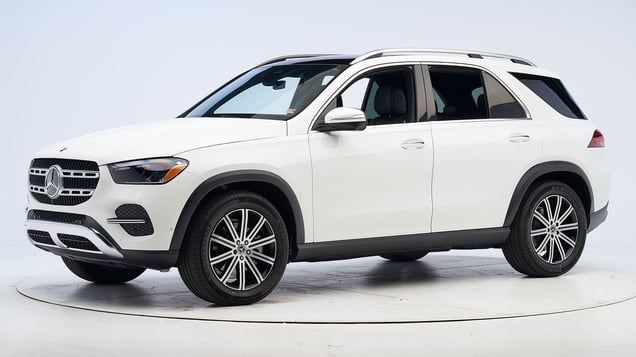
2027 Mercedes-Benz GLE-Class
midsize luxury SUV / 4-door SUV
Small overlap front
The small overlap front evaluation consists of a driver-side and a passenger-side component. If the results of the two evaluations differ, then the combined small overlap rating is equal to the lower rating.
Driver-side
Tested vehicle: 2024 Mercedes-Benz GLE-Class 4-door 4wd
Rating applies to 2024-27 models
The Mercedes-Benz GLE-Class was redesigned for the 2024 model year. Driver-side small overlap frontal ratings are assigned by the Institute based on a test of a 2024 GLE conducted by Mercedes-Benz.
| Evaluation criteria | Rating |
|---|---|
| Overall driver-side evaluation | |
| Structure and safety cage | |
| Driver injury measures | |
| Head/neck | |
| Chest | |
| Hip/thigh | |
| Lower leg/foot | |
| Driver restraints and dummy kinematics | |
Technical measurements for this test
Measures of occupant compartment intrusion on driver side
| Evaluation criteria | Measurement |
|---|---|
| Test ID | VTN2309 |
| Lower occupant compartment | |
| Lower hinge pillar max (cm) | 2 |
| Footrest (cm) | 2 |
| Left toepan (cm) | 2 |
| Brake pedal (cm) | 4 |
| Parking brake (cm) | 0 |
| Rocker panel lateral average (cm) | 0 |
| Upper occupant compartment | |
| Steering column | 0 |
| Upper hinge pillar max (cm) | 1 |
| Upper dash (cm) | 1 |
| Lower instrument panel (cm) | 1 |
Driver injury measures
| Evaluation criteria | Measurement |
|---|---|
| Test ID | VTN2309 |
| Head | |
| HIC-15 | 258 |
| Peak gs at hard contact | no contact |
| Neck | |
| Tension (kN) | 1.6 |
| Extension bending moment (Nm) | 7 |
| Maximum Nij | 0.26 |
| Chest maximum compression (mm) | 28 |
| Femur (kN) | |
| Left | 0.9 |
| Right | 0.9 |
| Knee displacement (mm) | |
| Left | 2 |
| Right | 3 |
| Knee-thigh-hip injury risk (%) | |
| Left | 0 |
| Right | 0 |
| Maximum tibia index | |
| Left | 0.44 |
| Right | 0.48 |
| Tibia axial force (kN) | |
| Left | 1.8 |
| Right | 1.4 |
| Foot acceleration (g) | |
| Left | 52 |
| Right | 57 |
Passenger-side
Tested vehicle: 2024 Mercedes-Benz GLE-Class 4-door 4wd
Rating applies to 2024-27 models
The Mercedes-Benz GLE-Class was redesigned for the 2024 model year. Passenger-side small overlap frontal ratings are assigned by the Institute based on a test of a 2024 GLE conducted by Mercedes-Benz.
| Evaluation criteria | Rating |
|---|---|
| Overall passenger-side evaluation | |
| Structure and safety cage | |
| Passenger injury measures | |
| Head/neck | |
| Chest | |
| Hip/thigh | |
| Lower leg/foot | |
| Passenger restraints and dummy kinematics | |
| Driver injury measures | |
| Head/neck | |
| Chest | |
| Hip/thigh | |
| Lower leg/foot | |
| Driver restraints and dummy kinematics | |
Technical measurements for this test
Measures of occupant compartment intrusion on passenger side
| Evaluation criteria | Measurement |
|---|---|
| Test ID | VTP2315 |
| Lower occupant compartment | |
| Lower hinge pillar max (cm) | 6 |
| Footrest (cm) | 9 |
| Right toepan (cm) | 6 |
| Center toepan (cm) | 4 |
| Rocker panel lateral average (cm) | 2 |
| Upper occupant compartment | |
| Center dash (cm) | 1 |
| Upper hinge pillar max (cm) | 4 |
| Upper dash (cm) | 4 |
| Right lower dash (cm) | 4 |
Passenger injury measures
| Evaluation criteria | Measurement |
|---|---|
| Test ID | VTP2315 |
| Head | |
| HIC-15 | 220 |
| Peak gs at hard contact | no contact |
| Neck | |
| Tension (kN) | 1.3 |
| Extension bending moment (Nm) | 11 |
| Maximum Nij | 0.20 |
| Chest maximum compression (mm) | 21 |
| Femur (kN) | |
| Left | 0.6 |
| Right | 0.8 |
| Knee displacement (mm) | |
| Left | 1 |
| Right | 1 |
| Knee-thigh-hip injury risk (%) | |
| Left | 0 |
| Right | 0 |
| Maximum tibia index | |
| Left | 0.24 |
| Right | 0.26 |
| Tibia axial force (kN) | |
| Left | 2.5 |
| Right | 2.6 |
| Foot acceleration (g) | |
| Left | 59 |
| Right | 78 |
Driver injury measures
| Evaluation criteria | Measurement |
|---|---|
| Test ID | VTP2315 |
| Head | |
| HIC-15 | 143 |
| Peak gs at hard contact | no contact |
| Neck | |
| Tension (kN) | 1.1 |
| Extension bending moment (Nm) | 6 |
| Maximum Nij | 0.22 |
| Chest maximum compression (mm) | 32 |
| Femur (kN) | |
| Left | 0.9 |
| Right | 0.4 |
| Knee displacement (mm) | |
| Left | 3 |
| Right | 1 |
| Knee-thigh-hip injury risk (%) | |
| Left | 0 |
| Right | 0 |
| Maximum tibia index | |
| Left | 0.35 |
| Right | 0.30 |
| Tibia axial force (kN) | |
| Left | 1.4 |
| Right | 1.5 |
| Foot acceleration (g) | |
| Left | 32 |
| Right | 47 |
Moderate overlap front: updated test
Tested vehicle: 2024 Mercedes-Benz GLE 350 4-door 4wd
Rating applies to 2024-27 models
The Mercedes-Benz GLE-Class was redesigned for the 2024 model year.
| Evaluation criteria | Rating |
|---|---|
| Overall evaluation | |
| Structure and safety cage | |
| Driver injury measures | |
| Head/neck | |
| Chest | |
| Thigh/hip | |
| Leg/foot | |
| Driver restraints and dummy kinematics | |
| Rear passenger injury measures | |
| Head/neck | |
| Chest | |
| Thigh | |
| Rear passenger restraints and dummy kinematics | |
Technical measurements for this test
Measures of occupant compartment intrusion on driver side
| Evaluation criteria | Measurement |
|---|---|
| Test ID | CEF2334 |
| Footwell intrusion | |
| Footrest (cm) | 2 |
| Left (cm) | 3 |
| Center (cm) | 2 |
| Right (cm) | 2 |
| Brake pedal (cm) | 2 |
| Instrument panel rearward movement | |
| Left (cm) | 0 |
| Right (cm) | 0 |
| Steering column movement | |
| Upward (cm) | 1 |
| Rearward (cm) | -2 |
| A-pillar rearward movement (cm) | 0 |
Driver injury measures
| Evaluation criteria | Measurement |
|---|---|
| Test ID | CEF2334 |
| Head | |
| HIC-15 | 232 |
| Peak gs at hard contact | no contact |
| Neck | |
| Tension (kN) | 1.3 |
| Extension bending moment (Nm) | 11 |
| Maximum Nij | 0.23 |
| Chest maximum compression (mm) | 31 |
| Femur (kN) | |
| Left | 0.9 |
| Right | 0.9 |
| Knee displacement (mm) | |
| Left | 2 |
| Right | 2 |
| Knee-thigh-hip injury risk (%) | |
| Left | 0 |
| Right | 0 |
| Maximum tibia index | |
| Left | 0.32 |
| Right | 0.35 |
| Tibia axial force (kN) | |
| Left | 1.9 |
| Right | 2.3 |
| Foot acceleration (g) | |
| Left | 61 |
| Right | 68 |
Rear passenger injury measures
| Test ID | CEF2334 |
|---|---|
| Head | |
| HIC-15 for head contact during forward excursion | no contact |
| Peak gs at hard contact | no contact |
| Neck | |
| Tension (kN) | 2.1 |
| Compression (kN) | 0.6 |
| Maximum Nij for head contact during forward excursion | no contact |
| Chest | |
| Chest index | 29 |
| Shoulder belt tension (kN) | 5.9 |
| Thigh (kN) | |
| Left femur compression | 0.2 |
| Right femur compression | 0.2 |
Side: updated test
Tested vehicle: 2024 Mercedes-Benz GLE-Class 4-door 4wd
Rating applies to 2024-27 models
The Mercedes-Benz GLE-Class was redesigned for the 2024 model year. Side 2.0 ratings are assigned by the Institute based on a test of a 2024 GLE conducted by Mercedes-Benz.
| Evaluation criteria | Rating |
|---|---|
| Overall evaluation | |
| Structure and safety cage | |
| Driver injury measures | |
| Head/neck | |
| Torso | |
| Pelvis | |
| Driver head protection | |
| Rear passenger injury measures | |
| Head/neck | |
| Torso | |
| Pelvis | |
| Rear passenger head protection | |
Technical measurements for this test
Measures of occupant compartment intrusion on driver side
| Evaluation criteria | Measurement |
|---|---|
| Test ID | VTS2331 |
| B-pillar to longitudinal centerline of driver's seat (cm) | -19.5 |
| Negative numbers indicate the amount by which the crush stopped short of the seat centerline. | |
Driver injury measures
| Evaluation criteria | Measurement |
|---|---|
| Test ID | VTS2331 |
| Head | |
| HIC-15 | 50 |
| Peak gs at hard contact | no data |
| Neck | |
| Tension (kN) | 0.9 |
| Compression (kN) | -0.2 |
| Shoulder | |
| Lateral deflection (mm) | 22 |
| Lateral force (kN) | 0.7 |
| Torso | |
| Maximum deflection (mm) | 34 |
| Average deflection (mm) | 30 |
| Maximum deflection rate (m/s) | 2.86 |
| Maximum viscous criterion (m/s) | 0.45 |
| Pelvis | |
| Combined force (kN) | 4.6 |
Passenger injury measures
| Evaluation criteria | Measurement |
|---|---|
| Test ID | VTS2331 |
| Head | |
| HIC-15 | 232 |
| Peak gs at hard contact | no contact |
| Neck | |
| Tension (kN) | 0.4 |
| Compression (kN) | -0.4 |
| Shoulder | |
| Lateral deflection (mm) | 7 |
| Lateral force (kN) | 0.4 |
| Torso | |
| Maximum deflection (mm) | 17 |
| Average deflection (mm) | 12 |
| Maximum deflection rate (m/s) | 3.00 |
| Maximum viscous criterion (m/s) | 0.16 |
| Pelvis | |
| Combined force (kN) | 5.0 |
Seat belt reminders
Rating applies to 2024-27 models
| Evaluation criteria | Rating |
|---|---|
| Overall evaluation | |
| Front row | |
| Unbelted occupant alert (audible & visual) | |
| Initiation time | Yes |
| Duration | Long enough (90+ seconds) |
| Volume | Yes |
| Audio frequency | Yes |
| Second row | |
| Startup status alert (visual) | |
| Initiation time | Yes |
| Duration at least 60 seconds | Yes |
| Belt disengaged alert (audible & visual) | |
| Initiation time | Yes |
| Duration at least 30 seconds | Yes |
| Volume | Yes |
| Audio frequency | Yes |
Technical measurements for this test
| Evaluation criteria | Measurement |
|---|---|
| Background cabin sound pressure level at 24 km/h | 50 dB |
| Audible signal sound pressure level at 24 km/h | 74 dB |
| Difference between background and signal | 23.0 dB |
| Background cabin sound pressure level at 40 km/h | 53 dB |
| Audible signal sound pressure level at 40 km/h | 71 dB |
| Difference between background and signal | 17.7 dB |
| Dominant audio frequency | 664 Hz |
Child seat anchors
Rating applies to 2020-27 models
| Evaluation criteria | Rating |
|---|---|
| Overall evaluation | |
| Vehicle trim | GLE 350 |
| Seat type | leather |
This vehicle has 2 rear seating positions with complete child seat attachment (LATCH) hardware. It has 1 additional seating position with a tether anchor only.
| Rating icon | Rating |
|---|---|
| G | Good |
| A | Acceptable |
| M | Marginal |
| P | Poor |
| Seating positions that rely on borrowed lower anchors or have only a tether anchor available are not rated. | |
thether anchor symbol | Tether anchor |
lower anchor symbol | Lower anchors |
| Lower anchor(s) can be borrowed from adjacent positions(s) | |
| No hardware available |
Details by seating position
| Position | Rating |
|---|---|
| 1 | |
| Tether anchor | |
| Yeseasy-to-find location | |
| Yesno other hardware could be confused for anchor | |
| Lower anchors | |
| Yesnot too deep in seat | |
| Yesnot too much force needed to attach | |
| Yeseasy to maneuver around anchors | |
| 2 | |
| Tether anchor | |
| Yeseasy-to-find location | |
| Yesno other hardware could be confused for anchor | |
| Lower anchors | |
| none available | |
| 3 | |
| Tether anchor | |
| Yeseasy-to-find location | |
| Yesno other hardware could be confused for anchor | |
| Lower anchors | |
| Yesnot too deep in seat | |
| Yesnot too much force needed to attach | |
| Yeseasy to maneuver around anchors |
Technical measurements for this test
Seat position 21
| Lower anchor A | |
|---|---|
| Open access rated | Yes |
| Depth | Visible |
| Force (lbs) | 0 |
| Clearance angle (degrees) | 88 |
| Lower anchor B | |
| Open access rated | Yes |
| Depth | Visible |
| Force (lbs) | 0 |
| Clearance angle (degrees) | 83 |
| Tether anchor | |
| Location | Middle seatback |
| Confusing hardware present | Yes |
| Has contrasting label within 3 inches of tether anchor |
Yes |
| Tether anchors can be accessed while seatback is properly positioned for use of LATCH |
Not measured |
Seat position 22
| Lower anchor A | |
|---|---|
| No lower latch for this seat position | |
| Lower anchor B | |
| No lower latch for this seat position | |
| Tether anchor | |
| Location | Middle seatback |
| Confusing hardware present | Yes |
| Has contrasting label within 3 inches of tether anchor |
Yes |
| Tether anchors can be accessed while seatback is properly positioned for use of LATCH |
Not measured |
Seat position 23
| Lower anchor A | |
|---|---|
| Open access rated | Yes |
| Depth | Visible |
| Force (lbs) | 0 |
| Clearance angle (degrees) | 88 |
| Lower anchor B | |
| Open access rated | Yes |
| Depth | Visible |
| Force (lbs) | 0 |
| Clearance angle (degrees) | 87 |
| Tether anchor | |
| Location | Middle seatback |
| Confusing hardware present | Yes |
| Has contrasting label within 3 inches of tether anchor |
Yes |
| Tether anchors can be accessed while seatback is properly positioned for use of LATCH |
Not measured |