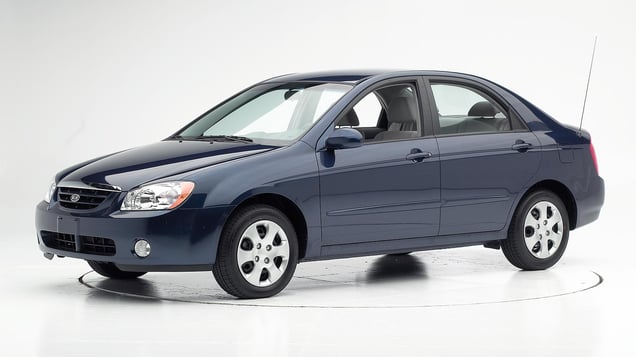
2004 Kia Spectra
small car / 4-door sedan
Moderate overlap front: original test
Tested vehicle: 2004 Kia Spectra EX 4-door
Rating applies to 2004-05 models built after November 2003 and before February 2005
The Kia Spectra was redesigned during the 2004 model year. (The old design was produced through November 2003; these cars are also designated as 2004 models.) All 2004 Spectra models manufactured after November 2003 are the redesigned cars. (Information about when a specific vehicle was manufactured is on the certification label typically affixed to the car on the driver door or adjacent B-pillar.)
The Institute evaluated a 2004 Spectra manufactured after November 2003. Forces on the head and neck were high, leading to a marginal head/neck injury rating. This rating, along with acceptable or marginal ratings for the chest and both legs, contributed to a poor overall rating. In response, Kia reduced the size of the driver airbag vent holes to lessen the injury forces occurring on the head and neck. Cars manufactured after January 2005 are equipped with the new airbag design.
The evaluation of the Spectra below is based on the test of the 2004 model. Because no structural changes were made, the structure rating is based on tests of both the 2004 and 2005 models.
| Evaluation criteria | Rating |
|---|---|
| Overall evaluation | |
| Structure and safety cage | |
| Driver injury measures | |
| Head/neck | |
| Chest | |
| Leg/foot, left | |
| Leg/foot, right | |
| Driver restraints and dummy kinematics Dummy movement wasn’t well controlled. The dummy's head bottomed out the airbag and hit the steering wheel. During rebound, the dummy's head moved partway out the open side window and hit the B-pillar. |
|
Technical measurements for this test
Measures of occupant compartment intrusion on driver side
| Evaluation criteria | Measurement | |
|---|---|---|
| Test ID | CEF0417 | CEF0502 |
| Footwell intrusion | ||
| Footrest (cm) | 18 | 12 |
| Left (cm) | 20 | 20 |
| Center (cm) | 18 | 17 |
| Right (cm) | 15 | 14 |
| Brake pedal (cm) | 16 | 15 |
| Instrument panel rearward movement | ||
| Left (cm) | 5 | 5 |
| Right (cm) | 5 | 4 |
| Steering column movement | ||
| Upward (cm) | 5 | 3 |
| Rearward (cm) | 0 | 1 |
| A-pillar rearward movement (cm) | 2 | 2 |
Driver injury measures
| Evaluation criteria | Measurement | |
|---|---|---|
| Test ID | CEF0417 | |
| Head | ||
| HIC-15 | 483 | |
| Peak gs at hard contact | 122 | |
| Neck | ||
| Tension (kN) | 2.8 | |
| Extension bending moment (Nm) | 43 | |
| Maximum Nij | 0.67 | |
| Chest maximum compression (mm) | 22 | |
| Legs | ||
| Femur force - left (kN) | 0.1 | |
| Femur force - right (kN) | 4.8 | |
| Knee displacement - left (mm) | 0 | |
| Knee displacement - right (mm) | 7 | |
| Maximum tibia index - left | 0.97 | |
| Maximum tibia index - right | 1.03 | |
| Tibia axial force - left (kN) | 1.6 | |
| Tibia axial force - right (kN) | 6.3 | |
| Foot acceleration (g) | ||
| Left | 47 | |
| Right | 118 | |
Side: original test
Tested vehicle: 2004 Kia Spectra EX 4-door with standard front and rear head curtain airbags and standard front seat-mounted torso airbags
Rating applies to 2004-08 models built after November 2003 and before September 2007
The Kia Spectra was redesigned during the 2004 model year. (The old design was produced through November 2003; these cars are also designated as 2004 models.) All 2004 and later Spectra models manufactured after November 2003 are the redesigned cars. (Information about when a specific vehicle was manufactured is on the certification label typically affixed to the car on the driver door or adjacent B-pillar.)
Kia has made structural and side torso airbag modifications beginning with 2008 models manufactured after August 2007, so these ratings do not apply to cars built after this date.
| Evaluation criteria | Rating |
|---|---|
| Overall evaluation | |
| Structure and safety cage | |
| Driver injury measures | |
| Head/neck | |
| Torso | |
| Pelvis/leg | |
| Driver head protection | |
| Rear passenger injury measures | |
| Head/neck | |
| Torso | |
| Pelvis/leg | |
| Rear passenger head protection | |
Technical measurements for this test
Measures of occupant compartment intrusion on driver side
| Test ID | CES0422 |
|---|---|
| B-pillar to longitudinal centerline of driver's seat (cm) | -2.5 |
| Negative numbers indicate the amount by which the crush stopped short of the seat centerline. | |
Driver injury measures
| Evaluation criteria | Measurement |
|---|---|
| Test ID | CES0422 |
| Head HIC-15 | 251 |
| Neck | |
| Tension (kN) | 1.1 |
| Compression (kN) | 0.5 |
| Shoulder | |
| Lateral deflection (mm) | 48 |
| Lateral force (kN) | 2.0 |
| Torso | |
| Maximum deflection (mm) | 58 |
| Average deflection (mm) | 53 |
| Maximum deflection rate (m/s) | 7.01 |
| Maximum viscous criterion (m/s) | 2.12 |
| Pelvis | |
| Iliac force (kN) | 3.8 |
| Acetabulum force (kN) | 2.5 |
| Combined force (kN) | 6.3 |
| Left femur | |
| L-M force (kN) | 0.3 |
| L-M moment (Nm) | 160 |
| A-P moment (Nm) | 31 |
Passenger injury measures
| Evaluation criteria | Measurement |
|---|---|
| Test ID | CES0422 |
| Head HIC-15 | 294 |
| Neck | |
| Tension (kN) | 0.3 |
| Compression (kN) | 0.5 |
| Shoulder | |
| Lateral deflection (mm) | 34 |
| Lateral force (kN) | 1.9 |
| Torso | |
| Maximum deflection (mm) | 55 |
| Average deflection (mm) | 35 |
| Maximum deflection rate (m/s) | 6.18 |
| Maximum viscous criterion (m/s) | 1.09 |
| Pelvis | |
| Iliac force (kN) | 0.4 |
| Acetabulum force (kN) | 1.5 |
| Combined force (kN) | 1.7 |
| Left femur | |
| L-M force (kN) | 0.8 |
| L-M moment (Nm) | 297 |
| A-P moment (Nm) | -158 |