2025 Infiniti QX50
midsize luxury SUV / 4-door SUV
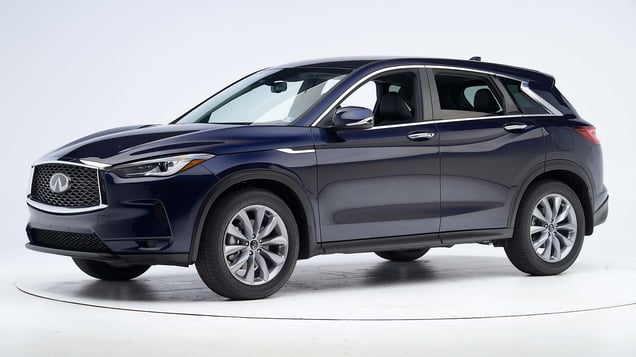
Side: updated test
Tested vehicle: 2022 Infiniti QX50 Pure 4-door 4wd
Rating applies to 2021-25 models
The Infiniti QX50 was redesigned for the 2019 model year after a one-year absence from the market. Beginning with 2021 models, rear side airbags were added, and design changes were implemented to the side structure, including the B-pillar, to improve occupant protection in side impact crashes.
Two side 2.0 tests of the QX50 were conducted, one by the Institute and the other by Nissan. Ratings are based on both tests, but the vehicle specifications shown below are based on the Institute’s test.
| Evaluation criteria | Rating |
|---|---|
| Overall evaluation | |
| Structure and safety cage | |
| Driver injury measures | |
| Head/neck | |
| Torso | |
| Pelvis | |
| Driver head protection | |
| Rear passenger injury measures | |
| Head/neck | |
| Torso | |
| Pelvis | |
| Rear passenger head protection | |
Technical measurements for this test
Measures of occupant compartment intrusion on driver side
| Evaluation criteria | Measurement | |
|---|---|---|
| Test ID | VTS2208 | CES2235 |
| B-pillar to longitudinal centerline of driver's seat (cm) | -11.5 | -13.0 |
| Negative numbers indicate the amount by which the crush stopped short of the seat centerline. | ||
Driver injury measures
| Evaluation criteria | Measurement | |
|---|---|---|
| Test ID | VTS2208 | CES2235 |
| Head | ||
| HIC-15 | 110 | 141 |
| Peak gs at hard contact | no contact | no contact |
| Neck | ||
| Tension (kN) | 0.9 | 0.8 |
| Compression (kN) | 0.3 | 0.4 |
| Shoulder | ||
| Lateral deflection (mm) | 28 | 27 |
| Lateral force (kN) | 0.8 | 0.8 |
| Torso | ||
| Maximum deflection (mm) | 43 | 44 |
| Average deflection (mm) | 37 | 36 |
| Maximum deflection rate (m/s) | 3.11 | 3.93 |
| Maximum viscous criterion (m/s) | 0.67 | 0.88 |
| Pelvis | ||
| Combined force (kN) | 5.8 | 5.9 |
Passenger injury measures
| Evaluation criteria | Measurement | |
|---|---|---|
| Test ID | VTS2208 | CES2235 |
| Head | ||
| HIC-15 | 70 | 57 |
| Peak gs at hard contact | no contact | no contact |
| Neck | ||
| Tension (kN) | 0.4 | 0.2 |
| Compression (kN) | 0.4 | 0.4 |
| Shoulder | ||
| Lateral deflection (mm) | 21 | 17 |
| Lateral force (kN) | 0.8 | 0.9 |
| Torso | ||
| Maximum deflection (mm) | 34 | 36 |
| Average deflection (mm) | 27 | 27 |
| Maximum deflection rate (m/s) | 2.91 | 3.04 |
| Maximum viscous criterion (m/s) | 0.26 | 0.33 |
| Pelvis | ||
| Combined force (kN) | 1.9 | 1.8 |