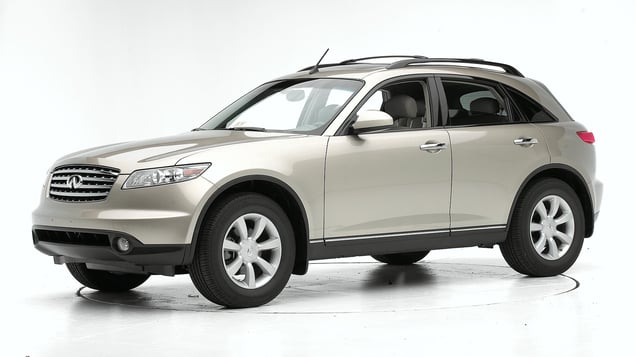
2007 Infiniti FX
midsize luxury SUV / 4-door SUV
Moderate overlap front: original test
Tested vehicle: 2003 Infiniti FX35 4-door 4wd
Rating applies to 2003-08 models
The Infiniti FX was introduced in the 2003 model year. There are two models, the FX35 (equipped with a V6 engine) and the FX45 (equipped with a V8 engine).
The Insurance Institute for Highway Safety has evaluated the crashworthiness of the FX in two 40 mph moderate overlap frontal crash tests into deformable barriers. In the first test, the driver frontal airbag deployed late, with the result that high forces were recorded on the dummy's head, indicating the likelihood of head injuries. This led Infiniti to modify the frontal airbag deployment characteristics on models produced after September 10, 2003. Also, Infiniti initiated a service campaign to modify at its cost vehicles produced earlier.
The Institute tested a second FX with the modified driver airbag, and the airbag inflated much earlier. Ratings of the FX are based on the results of the second test, except structural performance is based on both tests.
| Evaluation criteria | Rating |
|---|---|
| Overall evaluation | |
| Structure and safety cage | |
| Driver injury measures | |
| Head/neck | |
| Chest | |
| Leg/foot, left | |
| Leg/foot, right | |
| Driver restraints and dummy kinematics | |
Technical measurements for this test
Measures of occupant compartment intrusion on driver side
| Evaluation criteria | Measurement | |
|---|---|---|
| Test ID | CEF0324 | CEF0320 |
| Footwell intrusion | ||
| Footrest (cm) | 5 | 5 |
| Left (cm) | 5 | 5 |
| Center (cm) | 7 | 6 |
| Right (cm) | 6 | 6 |
| Brake pedal (cm) | 4 | 4 |
| Instrument panel rearward movement | ||
| Left (cm) | -1 | -2 |
| Right (cm) | -1 | -4 |
| Steering column movement | ||
| Upward (cm) | 4 | 3 |
| Rearward (cm) | -2 | -3 |
| A-pillar rearward movement (cm) | 0 | 0 |
Driver injury measures
| Evaluation criteria | Measurement | |
|---|---|---|
| Test ID | CEF0324 | |
| Head | ||
| HIC-15 | 539 | |
| Peak gs at hard contact | 87 | |
| Neck | ||
| Tension (kN) | 1.1 | |
| Extension bending moment (Nm) | 21 | |
| Maximum Nij | 0.24 | |
| Chest maximum compression (mm) | 24 | |
| Legs | ||
| Femur force - left (kN) | 1.9 | |
| Femur force - right (kN) | 3.5 | |
| Knee displacement - left (mm) | 0 | |
| Knee displacement - right (mm) | 0 | |
| Maximum tibia index - left | 0.28 | |
| Maximum tibia index - right | 0.36 | |
| Tibia axial force - left (kN) | 1.7 | |
| Tibia axial force - right (kN) | 1.9 | |
| Foot acceleration (g) | ||
| Left | 68 | |
| Right | 78 | |
Head restraints & seats
Seat type: All seats AHR
| Overall evaluation | |
|---|---|
| Dynamic rating | |
| Seat/head restraint geometry |
Technical measurements for this test
| Seat type | All seats AHR |
|---|---|
| Geometry | |
| Backset (mm) | 82 |
| Distance below top of head (mm) | 70 |
| Seat design parameters | |
| Pass/fail | Pass |
| Max T1 acceleration (g) | 9.2 |
| Head contact time (ms) | 110 |
| Force rating | 3 |
| Neck forces | |
| Max neck shear force (N) | 217 |
| Max neck tension (N) | 853 |
About the head restraint & seat test
Currently, IIHS tests apply only to front seats.