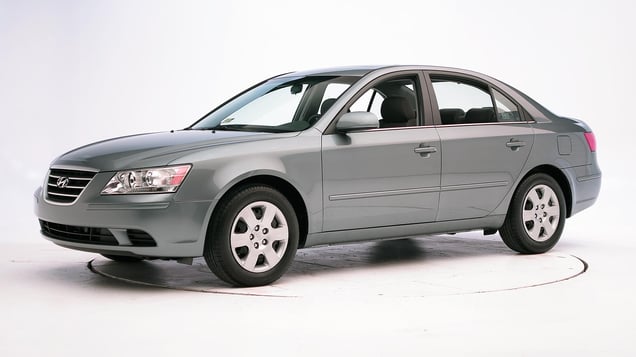
2009 Hyundai Sonata
midsize car / 4-door sedan
Moderate overlap front: original test
Tested vehicle: 2006 Hyundai Sonata GLS 4-door
Rating applies to 2006-10 models
The Hyundai Sonata was redesigned for the 2006 model year.
The Insurance Institute for Highway Safety has evaluated the crashworthiness of the Sonata in two 40 mph moderate overlap frontal crash tests into deformable barriers.
During the first test, the driver seat back failed to maintain its adjustment in its locked precrash position, resulting in forward rotation of the seat back into the inflated airbag. The seat back then moved rearward and after the crash was found in a semi-reclined position. Postcrash inspection showed the lap portion of the driver lap/shoulder belt was partially caught beneath the seat back adjustment lever and had likely activated the lever during the crash.
Starting on August 1, 2005, Hyundai put into production a new seat back adjustment lever designed to minimize interaction with the seat belt and ensure the belt cannot slide between the lever and the plastic trim on the side of the seat. Hyundai has recalled all 2006 Sonatas manufactured before August 1 to replace the levers at its cost.
A second test was conducted to assess the effect of the fix. Hyundai sent the Institute a replacement seat back adjustment lever that was retrofitted in a Sonata produced before August 1, 2005. In the second test, the seat back remained in place.
The evaluation of the Sonata is based on the second test, except for the structural rating, which is based both tests.
| Evaluation criteria | Rating |
|---|---|
| Overall evaluation | |
| Structure and safety cage | |
| Driver injury measures | |
| Head/neck | |
| Chest | |
| Leg/foot, left | |
| Leg/foot, right | |
| Driver restraints and dummy kinematics | |
Technical measurements for this test
Measures of occupant compartment intrusion on driver side
| Evaluation criteria | Measurement | |
|---|---|---|
| Test ID | CEF0525 | CEF0526 |
| Footwell intrusion | ||
| Footrest (cm) | 8 | 10 |
| Left (cm) | 10 | 9 |
| Center (cm) | 15 | 16 |
| Right (cm) | 9 | 10 |
| Brake pedal (cm) | 12 | 12 |
| Instrument panel rearward movement | ||
| Left (cm) | 5 | 6 |
| Right (cm) | 6 | 7 |
| Steering column movement | ||
| Upward (cm) | 5 | 6 |
| Rearward (cm) | 2 | 5 |
| A-pillar rearward movement (cm) | 1 | 2 |
Driver injury measures
| Evaluation criteria | Measurement | |
|---|---|---|
| Test ID | CEF0526 | |
| Head | ||
| HIC-15 | 212 | |
| Peak gs at hard contact | 44 | |
| Neck | ||
| Tension (kN) | 1.2 | |
| Extension bending moment (Nm) | 12 | |
| Maximum Nij | 0.68 | |
| Chest maximum compression (mm) | 37 | |
| Legs | ||
| Femur force - left (kN) | 1.9 | |
| Femur force - right (kN) | 4.3 | |
| Knee displacement - left (mm) | 7 | |
| Knee displacement - right (mm) | 6 | |
| Maximum tibia index - left | 0.44 | |
| Maximum tibia index - right | 0.68 | |
| Tibia axial force - left (kN) | 1.6 | |
| Tibia axial force - right (kN) | 2.3 | |
| Foot acceleration (g) | ||
| Left | 87 | |
| Right | 45 | |
Side: original test
Tested vehicle: 2006 Hyundai Sonata GLS 4-door with standard front and rear head curtain airbags and standard front seat-mounted torso airbags
Rating applies to 2006-10 models
The Hyundai Sonata was redesigned for the 2006 model year.
| Evaluation criteria | Rating |
|---|---|
| Overall evaluation | |
| Structure and safety cage | |
| Driver injury measures | |
| Head/neck | |
| Torso | |
| Pelvis/leg | |
| Driver head protection | |
| Rear passenger injury measures | |
| Head/neck | |
| Torso | |
| Pelvis/leg | |
| Rear passenger head protection | |
Technical measurements for this test
Measures of occupant compartment intrusion on driver side
| Test ID | CES0520 |
|---|---|
| B-pillar to longitudinal centerline of driver's seat (cm) | -1.0 |
| Negative numbers indicate the amount by which the crush stopped short of the seat centerline. | |
Driver injury measures
| Evaluation criteria | Measurement |
|---|---|
| Test ID | CES0520 |
| Head HIC-15 | 294 |
| Neck | |
| Tension (kN) | 1.2 |
| Compression (kN) | 0.1 |
| Shoulder | |
| Lateral deflection (mm) | 48 |
| Lateral force (kN) | 1.9 |
| Torso | |
| Maximum deflection (mm) | 49 |
| Average deflection (mm) | 39 |
| Maximum deflection rate (m/s) | 6.60 |
| Maximum viscous criterion (m/s) | 1.17 |
| Pelvis | |
| Iliac force (kN) | 4.6 |
| Acetabulum force (kN) | 3.2 |
| Combined force (kN) | 7.7 |
| Left femur | |
| L-M force (kN) | 0.4 |
| L-M moment (Nm) | 65 |
| A-P moment (Nm) | 44 |
Passenger injury measures
| Evaluation criteria | Measurement |
|---|---|
| Test ID | CES0520 |
| Head HIC-15 | 174 |
| Neck | |
| Tension (kN) | 0.6 |
| Compression (kN) | 0.2 |
| Shoulder | |
| Lateral deflection (mm) | 29 |
| Lateral force (kN) | 1.5 |
| Torso | |
| Maximum deflection (mm) | 35 |
| Average deflection (mm) | 31 |
| Maximum deflection rate (m/s) | 3.22 |
| Maximum viscous criterion (m/s) | 0.54 |
| Pelvis | |
| Iliac force (kN) | 0.6 |
| Acetabulum force (kN) | 2.4 |
| Combined force (kN) | 3.0 |
| Left femur | |
| L-M force (kN) | 0.4 |
| L-M moment (Nm) | 89 |
| A-P moment (Nm) | -52 |
Roof strength
Tested vehicle: 2009 Hyundai Sonata GLS 4-door
Rating applies to 2006-10 models
| Overall evaluation | |
|---|---|
| Curb weight | 3,312 lbs |
| Peak force | 10,332 lbs |
| Strength-to-weight ratio | 3.12 |
Head restraints & seats
Seat type: Manual cloth seats AHR
| Overall evaluation | |
|---|---|
| Dynamic rating | |
| Seat/head restraint geometry |
Technical measurements for this test
| Seat type | Manual cloth seats AHR |
|---|---|
| Geometry | |
| Backset (mm) | 45 |
| Distance below top of head (mm) | 55 |
| Seat design parameters | |
| Pass/fail | Pass |
| Max T1 acceleration (g) | 10.1 |
| Head contact time (ms) | 64 |
| Force rating | 1 |
| Neck forces | |
| Max neck shear force (N) | 59 |
| Max neck tension (N) | 585 |
About the head restraint & seat test
Currently, IIHS tests apply only to front seats.