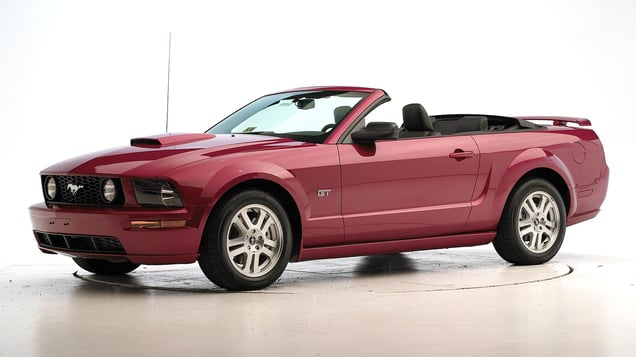
2009 Ford Mustang
midsize car / 2-door convertible
Moderate overlap front: original test
Tested vehicle: 2007 Ford Mustang GT 2-door convertible
Rating applies to 2007-09 models built after May 2007
The Ford Mustang was redesigned for the 2005 model year and modified beginning with 2007 models manufactured after May 2007 to reduce the likelihood of door opening in frontal offset crashes (note: information about when a specific vehicle was manufactured is on the certification label typically affixed to the car on or near the driver door).
Two tests of a 2007 Mustang convertible were conducted, one before the door modifications were made, and one after. During the first crash test, the window glass in the down position pushed on the driver door latch linkage, and the door opened. Ford responded by adding structure in the doors to prevent the window glass from contacting the latch mechanism and asked the Institute to test the Mustang again. In the second test, the driver door did not open.
The two cars are rated separately, but the overall rating for each is Acceptable.
| Evaluation criteria | Rating |
|---|---|
| Overall evaluation | |
| Structure and safety cage | |
| Driver injury measures | |
| Head/neck | |
| Chest | |
| Leg/foot, left | |
| Leg/foot, right | |
| Driver restraints and dummy kinematics Dummy movement was reasonably well controlled. The dummy's head hit the A-pillar, which bent downward and inward during the crash. |
|
Technical measurements for this test
Measures of occupant compartment intrusion on driver side
| Evaluation criteria | Measurement |
|---|---|
| Test ID | CEF0715 |
| Footwell intrusion | |
| Footrest (cm) | 13 |
| Left (cm) | 16 |
| Center (cm) | 20 |
| Right (cm) | 18 |
| Brake pedal (cm) | 9 |
| Instrument panel rearward movement | |
| Left (cm) | 4 |
| Right (cm) | 3 |
| Steering column movement | |
| Upward (cm) | 1 |
| Rearward (cm) | 8 |
| A-pillar rearward movement (cm) | 8 |
Driver injury measures
| Evaluation criteria | Measurement |
|---|---|
| Test ID | CEF0715 |
| Head | |
| HIC-15 | 275 |
| Peak gs at hard contact | 83 |
| Neck | |
| Tension (kN) | 0.9 |
| Extension bending moment (Nm) | 21 |
| Maximum Nij | 0.33 |
| Chest maximum compression (mm) | 26 |
| Legs | |
| Femur force - left (kN) | 3.5 |
| Femur force - right (kN) | 1.6 |
| Knee displacement - left (mm) | 0 |
| Knee displacement - right (mm) | 0 |
| Maximum tibia index - left | 0.24 |
| Maximum tibia index - right | 0.83 |
| Tibia axial force - left (kN) | 1.7 |
| Tibia axial force - right (kN) | 2.5 |
| Foot acceleration (g) | |
| Left | 52 |
| Right | 91 |
Side: original test
Tested vehicle: 2007 Ford Mustang GT 2-door convertible with optional front seat-mounted combination head and torso airbags
Rating applies to 2008-09 models
The Ford Mustang was redesigned for the 2005 model year. Beginning with 2007 models manufactured after January 2007, the optional side airbags were modified to improve occupant protection in side impact crashes (note: information about when a specific vehicle was manufactured is on the certification label typically affixed to the car on or near the driver door). Beginning with 2008 models, the side airbags were made standard.
| Evaluation criteria | Rating |
|---|---|
| Overall evaluation | |
| Structure and safety cage | |
| Driver injury measures | |
| Head/neck | |
| Torso | |
| Pelvis/leg | |
| Driver head protection | |
| Rear passenger injury measures | |
| Head/neck | |
| Torso | |
| Pelvis/leg | |
| Rear passenger head protection The dummy's head was hit by the interior side trim and convertible boot (cover for the folded roof). These impacts did not produce high head injury measures, but the head protection is inadequate. |
|
Technical measurements for this test
Measures of occupant compartment intrusion on driver side
| Test ID | CES0703 |
|---|---|
| B-pillar to longitudinal centerline of driver's seat (cm) | -17.0 |
| Negative numbers indicate the amount by which the crush stopped short of the seat centerline. | |
Driver injury measures
| Evaluation criteria | Measurement |
|---|---|
| Test ID | CES0703 |
| Head HIC-15 | 213 |
| Neck | |
| Tension (kN) | 0.7 |
| Compression (kN) | 0.7 |
| Shoulder | |
| Lateral deflection (mm) | 44 |
| Lateral force (kN) | 1.8 |
| Torso | |
| Maximum deflection (mm) | 46 |
| Average deflection (mm) | 38 |
| Maximum deflection rate (m/s) | 4.27 |
| Maximum viscous criterion (m/s) | 0.86 |
| Pelvis | |
| Iliac force (kN) | 1.7 |
| Acetabulum force (kN) | 3.4 |
| Combined force (kN) | 4.9 |
| Left femur | |
| L-M force (kN) | 0.5 |
| L-M moment (Nm) | 95 |
| A-P moment (Nm) | 43 |
Passenger injury measures
| Evaluation criteria | Measurement |
|---|---|
| Test ID | CES0703 |
| Head HIC-15 | 287 |
| Neck | |
| Tension (kN) | 1.2 |
| Compression (kN) | 0.1 |
| Shoulder | |
| Lateral deflection (mm) | 29 |
| Lateral force (kN) | 1.9 |
| Torso | |
| Maximum deflection (mm) | 27 |
| Average deflection (mm) | 18 |
| Maximum deflection rate (m/s) | 2.85 |
| Maximum viscous criterion (m/s) | 0.37 |
| Pelvis | |
| Iliac force (kN) | 0.3 |
| Acetabulum force (kN) | 1.2 |
| Combined force (kN) | 1.5 |
| Left femur | |
| L-M force (kN) | 1.1 |
| L-M moment (Nm) | 135 |
| A-P moment (Nm) | -19 |
Head restraints & seats
Seat type: Manual-power leather seats
| Overall evaluation | |
|---|---|
| Dynamic rating | |
| Seat/head restraint geometry |
Technical measurements for this test
| Seat type | Manual-power leather seats |
|---|---|
| Geometry | |
| Backset (mm) | 25 |
| Distance below top of head (mm) | 28 |
| Seat design parameters | |
| Pass/fail | Fail |
| Max T1 acceleration (g) | 10.9 |
| Head contact time (ms) | 94 |
| Force rating | 3 |
| Neck forces | |
| Max neck shear force (N) | 269 |
| Max neck tension (N) | 704 |
About the head restraint & seat test
Currently, IIHS tests apply only to front seats.