2027 Chrysler Pacifica
minivan
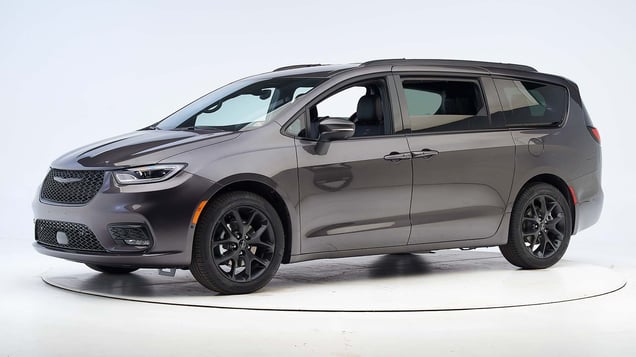
Small overlap front
The small overlap front evaluation consists of a driver-side and a passenger-side component. If the results of the two evaluations differ, then the combined small overlap rating is equal to the lower rating.
Driver-side
Tested vehicle: 2017 Chrysler Pacifica Touring
Rating applies to 2017-27 models built after August 2016
The Chrysler Pacifica was introduced in the 2017 model year as a replacement for the Chrysler Town and Country minivan. The Chrysler Voyager, available new only to fleet buyers, was introduced in the 2020 model year and shares the same platform as the Pacifica.
Two tests of the Pacifica were conducted because the driver door was torn off its hinges in the first test. As a result, Fiat Chrysler strengthened the upper hinge and reinforced the joint between the door hinge pillar and inner body panel in front of the pillar. In the second test, the upper hinge held and the door stayed shut.
The small overlap frontal ratings listed below apply only to vehicles built after August 2016, that is after the door hinge improvements were made. (Information about when a specific vehicle was manufactured is on the certification label typically affixed to the car on the driver door or adjacent B-pillar.)
| Evaluation criteria | Rating |
|---|---|
| Overall driver-side evaluation | |
| Structure and safety cage | |
| Driver injury measures | |
| Head/neck | |
| Chest | |
| Hip/thigh | |
| Lower leg/foot | |
| Driver restraints and dummy kinematics | |
Technical measurements for this test
Measures of occupant compartment intrusion on driver side
| Evaluation criteria | Measurement |
|---|---|
| Test ID | CEN1635 |
| Lower occupant compartment | |
| Lower hinge pillar max (cm) | 12 |
| Footrest (cm) | 14 |
| Left toepan (cm) | 11 |
| Brake pedal (cm) | 5 |
| Parking brake (cm) | |
| Rocker panel lateral average (cm) | 4 |
| Upper occupant compartment | |
| Steering column | 2 |
| Upper hinge pillar max (cm) | 7 |
| Upper dash (cm) | 8 |
| Lower instrument panel (cm) | 9 |
Driver injury measures
| Evaluation criteria | Measurement |
|---|---|
| Test ID | CEN1635 |
| Head | |
| HIC-15 | 71 |
| Peak gs at hard contact | no contact |
| Neck | |
| Tension (kN) | 0.8 |
| Extension bending moment (Nm) | 8 |
| Maximum Nij | 0.18 |
| Chest maximum compression (mm) | 20 |
| Femur (kN) | |
| Left | 1.2 |
| Right | 0.8 |
| Knee displacement (mm) | |
| Left | 2 |
| Right | 1 |
| Knee-thigh-hip injury risk (%) | |
| Left | 0 |
| Right | 0 |
| Maximum tibia index | |
| Left | 0.73 |
| Right | 0.31 |
| Tibia axial force (kN) | |
| Left | 2.2 |
| Right | 1.7 |
| Foot acceleration (g) | |
| Left | 45 |
| Right | 28 |
Passenger-side
Tested vehicle: 2020 Chrysler Pacifica Touring Plus 4-door
Rating applies to 2020-27 models built after August 2020
The Chrysler Pacifica was introduced in the 2017 model year as a replacement for the Chrysler Town and Country minivan. The Chrysler Voyager, available new only to fleet buyers, was introduced in the 2020 model year and shares the same platform as the Pacifica.
Beginning with 2020 models built after August 2020, the passenger front door hinge pillar, A-pillar and door sill was strengthened to improve occupant protection in passenger-side small overlap frontal crashes. (Information about when a specific vehicle was manufactured is on the certification label typically affixed to the car on the driver door or adjacent B-pillar.)
Passenger-side small overlap frontal ratings are assigned by the Institute based on a test of a 2020 Chrysler Pacificia conducted by Fiat Chrysler.
| Evaluation criteria | Rating |
|---|---|
| Overall passenger-side evaluation | |
| Structure and safety cage | |
| Passenger injury measures | |
| Head/neck | |
| Chest | |
| Hip/thigh | |
| Lower leg/foot | |
| Passenger restraints and dummy kinematics | |
| Driver injury measures | |
| Head/neck | |
| Chest | |
| Hip/thigh | |
| Lower leg/foot | |
| Driver restraints and dummy kinematics | |
Technical measurements for this test
Measures of occupant compartment intrusion on passenger side
| Evaluation criteria | Measurement |
|---|---|
| Test ID | VTP2013 |
| Lower occupant compartment | |
| Lower hinge pillar max (cm) | 11 |
| Footrest (cm) | 15 |
| Right toepan (cm) | 9 |
| Center toepan (cm) | 2 |
| Rocker panel lateral average (cm) | 3 |
| Upper occupant compartment | |
| Center dash (cm) | 5 |
| Upper hinge pillar max (cm) | 5 |
| Upper dash (cm) | 7 |
| Right lower dash (cm) | 7 |
Passenger injury measures
| Evaluation criteria | Measurement |
|---|---|
| Test ID | VTP2013 |
| Head | |
| HIC-15 | 55 |
| Peak gs at hard contact | no contact |
| Neck | |
| Tension (kN) | 1.0 |
| Extension bending moment (Nm) | 9 |
| Maximum Nij | 0.21 |
| Chest maximum compression (mm) | 23 |
| Femur (kN) | |
| Left | 1.6 |
| Right | 1.7 |
| Knee displacement (mm) | |
| Left | 3 |
| Right | 4 |
| Knee-thigh-hip injury risk (%) | |
| Left | 0 |
| Right | 0 |
| Maximum tibia index | |
| Left | 0.45 |
| Right | 0.48 |
| Tibia axial force (kN) | |
| Left | 2.8 |
| Right | 1.9 |
| Foot acceleration (g) | |
| Left | 36 |
| Right | 33 |
Driver injury measures
| Evaluation criteria | Measurement |
|---|---|
| Test ID | VTP2013 |
| Head | |
| HIC-15 | 36 |
| Peak gs at hard contact | no contact |
| Neck | |
| Tension (kN) | 0.9 |
| Extension bending moment (Nm) | 7 |
| Maximum Nij | 0.14 |
| Chest maximum compression (mm) | 29 |
| Femur (kN) | |
| Left | 0.1 |
| Right | 0.3 |
| Knee displacement (mm) | |
| Left | 0 |
| Right | 0 |
| Knee-thigh-hip injury risk (%) | |
| Left | 0 |
| Right | 0 |
| Maximum tibia index | |
| Left | 0.40 |
| Right | 0.34 |
| Tibia axial force (kN) | |
| Left | 0.5 |
| Right | 0.3 |
| Foot acceleration (g) | |
| Left | 37 |
| Right | 28 |
Moderate overlap front: updated test
Tested vehicle: 2023 Chrysler Pacifica Touring L 4-door
Rating applies to 2023-27 models
The Chrysler Pacifica was introduced in the 2017 model year as a replacement for the Chrysler Town and Country minivan. These ratings do not apply to the Chrysler Voyager.
| Evaluation criteria | Rating |
|---|---|
| Overall evaluation | |
| Structure and safety cage | |
| Driver injury measures | |
| Head/neck | |
| Chest | |
| Thigh/hip | |
| Leg/foot | |
| Driver restraints and dummy kinematics | |
| Rear passenger injury measures | |
| Head/neck | |
| Chest | |
| Thigh | |
|
Rear passenger restraints and dummy kinematics
| |
Technical measurements for this test
Measures of occupant compartment intrusion on driver side
| Evaluation criteria | Measurement |
|---|---|
| Test ID | CEF2320 |
| Footwell intrusion | |
| Footrest (cm) | 8 |
| Left (cm) | 11 |
| Center (cm) | 10 |
| Right (cm) | 10 |
| Brake pedal (cm) | 8 |
| Instrument panel rearward movement | |
| Left (cm) | 1 |
| Right (cm) | 1 |
| Steering column movement | |
| Upward (cm) | 2 |
| Rearward (cm) | -2 |
| A-pillar rearward movement (cm) | 1 |
Driver injury measures
| Evaluation criteria | Measurement |
|---|---|
| Test ID | CEF2320 |
| Head | |
| HIC-15 | 155 |
| Peak gs at hard contact | 20 |
| Neck | |
| Tension (kN) | 1.0 |
| Extension bending moment (Nm) | 10 |
| Maximum Nij | 0.24 |
| Chest maximum compression (mm) | 29 |
| Femur (kN) | |
| Left | 0.8 |
| Right | 1.3 |
| Knee displacement (mm) | |
| Left | 1 |
| Right | 1 |
| Knee-thigh-hip injury risk (%) | |
| Left | 0 |
| Right | 0 |
| Maximum tibia index | |
| Left | 0.70 |
| Right | 0.73 |
| Tibia axial force (kN) | |
| Left | 2.1 |
| Right | 3.3 |
| Foot acceleration (g) | |
| Left | 60 |
| Right | 88 |
Rear passenger injury measures
| Test ID | CEF2320 |
|---|---|
| Head | |
| HIC-15 for head contact during forward excursion | no contact |
| Peak gs at hard contact | no contact |
| Neck | |
| Tension (kN) | 2.1 |
| Compression (kN) | 0.2 |
| Maximum Nij for head contact during forward excursion | no contact |
| Chest | |
| Chest index | 34 |
| Shoulder belt tension (kN) | 6.4 |
| Thigh (kN) | |
| Left femur compression | 0.2 |
| Right femur compression | 0.2 |
Side: updated test
Tested vehicle: 2023 Chrysler Pacifica Touring L 4-door
Rating applies to 2023-27 models
The Chrysler Pacifica was introduced in the 2017 model year as a replacement for the Chrysler Town and Country minivan. The Chrysler Voyager, available new only to fleet buyers, was introduced in the 2020 model year and shares the same platform as the Pacifica. Beginning with 2023 models, a side energy absorber was added to the front door. Additionally, beginning with 2023 models built after August, a revised latch for the rear sliding doors was implemented to improve occupant safety in side impact crashes. (Information about when a specific vehicle was manufactured is on the certification label typically affixed to the car on the driver door or adjacent B-pillar.)
| Evaluation criteria | Rating |
|---|---|
| Overall evaluation | |
| Structure and safety cage | |
| Driver injury measures | |
| Head/neck | |
| Torso | |
| Pelvis | |
| Driver head protection | |
| Rear passenger injury measures | |
| Head/neck | |
| Torso | |
| Pelvis | |
| Rear passenger head protection | |
Technical measurements for this test
Measures of occupant compartment intrusion on driver side
| Evaluation criteria | Measurement |
|---|---|
| Test ID | CES2315 |
| B-pillar to longitudinal centerline of driver's seat (cm) | -23.0 |
| Negative numbers indicate the amount by which the crush stopped short of the seat centerline. | |
Driver injury measures
| Evaluation criteria | Measurement |
|---|---|
| Test ID | CES2315 |
| Head | |
| HIC-15 | 167 |
| Peak gs at hard contact | no contact |
| Neck | |
| Tension (kN) | 1.5 |
| Compression (kN) | 0.2 |
| Shoulder | |
| Lateral deflection (mm) | 24 |
| Lateral force (kN) | 1.0 |
| Torso | |
| Maximum deflection (mm) | 32 |
| Average deflection (mm) | 27 |
| Maximum deflection rate (m/s) | 2.36 |
| Maximum viscous criterion (m/s) | 0.32 |
| Pelvis | |
| Combined force (kN) | 3.8 |
Passenger injury measures
| Evaluation criteria | Measurement |
|---|---|
| Test ID | CES2315 |
| Head | |
| HIC-15 | 83 |
| Peak gs at hard contact | no contact |
| Neck | |
| Tension (kN) | 0.5 |
| Compression (kN) | 0.3 |
| Shoulder | |
| Lateral deflection (mm) | 28 |
| Lateral force (kN) | 1.9 |
| Torso | |
| Maximum deflection (mm) | 50 |
| Average deflection (mm) | 23 |
| Maximum deflection rate (m/s) | 5.42 |
| Maximum viscous criterion (m/s) | 1.11 |
| Pelvis | |
| Combined force (kN) | 6.5 |
Headlights
Trim level(s): LX trim, trim
| Evaluation criteria | Rating |
|---|---|
| Low-beam headlight type | Halogen reflector |
| High-beam headlight type | Halogen reflector |
| Curve-adaptive? | No |
| High-beam assist? | No |
|
Overall rating | |
| Distance at which headlights provide at least 5 lux illumination: | |
Low beams
On the straightaway, visibility was inadequate on both sides of the road. On curves, visibility was inadequate in all 4 tests.
The low beams never exceeded glare limits.
High beams
On the straightaway, visibility was inadequate on both sides of the road. On curves, visibility was inadequate in all 4 tests.
Technical measurements for this test
| Evaluation criteria | Measurement |
|---|---|
| Trim level(s) |
|
| Low-beam headlight type | Halogen reflector |
| High-beam headlight type | Halogen reflector |
| Curve-adaptive? | No |
| High-beam assist? | No |
|
Overall rating Applies to 2017-27 models |
| LOW BEAMS | Average minimum useful illumination distance (5 lux) |
Amount glare exceeded threshold |
|---|---|---|
| Straightaway right edge | 68.7 m | None |
| Straightaway left edge | 37.0 m | None |
| 250m radius right curve, right edge | 39.6 m | None |
| 250m radius left curve, left edge | 37.5 m | None |
| 150m radius right curve, right edge | 36.1 m | None |
| 150m radius left curve, left edge | 34.7 m | None |
| HIGH BEAMS | Average minimum useful illumination distance (5 lux) |
|---|---|
| Straightaway right edge | 117.4 m |
| Straightaway left edge | 79.3 m |
| 250m radius right curve, right edge | 47.8 m |
| 250m radius left curve, left edge | 48.9 m |
| 150m radius right curve, right edge | 41.0 m |
| 150m radius left curve, left edge | 40.9 m |