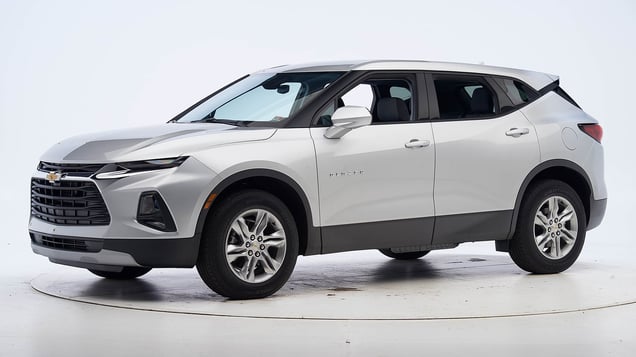
2026 Chevrolet Blazer
midsize SUV / 4-door SUV
Small overlap front
The small overlap front evaluation consists of a driver-side and a passenger-side component. If the results of the two evaluations differ, then the combined small overlap rating is equal to the lower rating.
Driver-side
Tested vehicle: 2020 Chevrolet Blazer 4-door 4wd
Rating applies to 2019-26 models
The Chevrolet Blazer was reintroduced in the 2019 model year.
| Evaluation criteria | Rating |
|---|---|
| Overall driver-side evaluation | |
| Structure and safety cage | |
| Driver injury measures | |
| Head/neck | |
| Chest | |
| Hip/thigh | |
| Lower leg/foot | |
| Driver restraints and dummy kinematics | |
Technical measurements for this test
Measures of occupant compartment intrusion on driver side
| Evaluation criteria | Measurement |
|---|---|
| Test ID | CEN2007 |
| Lower occupant compartment | |
| Lower hinge pillar max (cm) | 1 |
| Footrest (cm) | 1 |
| Left toepan (cm) | 5 |
| Brake pedal (cm) | 2 |
| Parking brake (cm) | |
| Rocker panel lateral average (cm) | 1 |
| Upper occupant compartment | |
| Steering column | 0 |
| Upper hinge pillar max (cm) | 1 |
| Upper dash (cm) | 1 |
| Lower instrument panel (cm) | 0 |
Driver injury measures
| Evaluation criteria | Measurement |
|---|---|
| Test ID | CEN2007 |
| Head | |
| HIC-15 | 90 |
| Peak gs at hard contact | no contact |
| Neck | |
| Tension (kN) | 0.6 |
| Extension bending moment (Nm) | 7 |
| Maximum Nij | 0.15 |
| Chest maximum compression (mm) | 19 |
| Femur (kN) | |
| Left | 0.2 |
| Right | 0.1 |
| Knee displacement (mm) | |
| Left | 0 |
| Right | 0 |
| Knee-thigh-hip injury risk (%) | |
| Left | 0 |
| Right | 0 |
| Maximum tibia index | |
| Left | 0.68 |
| Right | 0.58 |
| Tibia axial force (kN) | |
| Left | 0.9 |
| Right | 1.1 |
| Foot acceleration (g) | |
| Left | 42 |
| Right | 44 |
Passenger-side
Tested vehicle: 2020 Chevrolet Blazer Premiere 4-door 4wd
Rating applies to 2019-26 models
The Chevrolet Blazer was reintroduced in the 2019 model year. Passenger-side small overlap frontal ratings are assigned by the Institute based on a test of a 2020 Chevrolet Blazer conducted by General Motors.
| Evaluation criteria | Rating |
|---|---|
| Overall passenger-side evaluation | |
| Structure and safety cage | |
| Passenger injury measures | |
| Head/neck | |
| Chest | |
| Hip/thigh | |
| Lower leg/foot | |
| Passenger restraints and dummy kinematics | |
| Driver injury measures | |
| Head/neck | |
| Chest | |
| Hip/thigh | |
| Lower leg/foot | |
| Driver restraints and dummy kinematics | |
Technical measurements for this test
Measures of occupant compartment intrusion on passenger side
| Evaluation criteria | Measurement |
|---|---|
| Test ID | VTP2023 |
| Lower occupant compartment | |
| Lower hinge pillar max (cm) | 11 |
| Footrest (cm) | 3 |
| Right toepan (cm) | 2 |
| Center toepan (cm) | 3 |
| Rocker panel lateral average (cm) | 2 |
| Upper occupant compartment | |
| Center dash (cm) | 5 |
| Upper hinge pillar max (cm) | 9 |
| Upper dash (cm) | 9 |
| Right lower dash (cm) | 12 |
Passenger injury measures
| Evaluation criteria | Measurement |
|---|---|
| Test ID | VTP2023 |
| Head | |
| HIC-15 | 90 |
| Peak gs at hard contact | no contact |
| Neck | |
| Tension (kN) | 1.1 |
| Extension bending moment (Nm) | 7 |
| Maximum Nij | 0.21 |
| Chest maximum compression (mm) | 18 |
| Femur (kN) | |
| Left | 1.5 |
| Right | 0.7 |
| Knee displacement (mm) | |
| Left | 3 |
| Right | 2 |
| Knee-thigh-hip injury risk (%) | |
| Left | 0 |
| Right | 0 |
| Maximum tibia index | |
| Left | 0.59 |
| Right | 0.59 |
| Tibia axial force (kN) | |
| Left | 1.0 |
| Right | 1.1 |
| Foot acceleration (g) | |
| Left | 42 |
| Right | 28 |
Driver injury measures
| Evaluation criteria | Measurement |
|---|---|
| Test ID | VTP2023 |
| Head | |
| HIC-15 | 50 |
| Peak gs at hard contact | no contact |
| Neck | |
| Tension (kN) | 1.0 |
| Extension bending moment (Nm) | 46 |
| Maximum Nij | 0.45 |
| Chest maximum compression (mm) | 16 |
| Femur (kN) | |
| Left | 0.5 |
| Right | 0.3 |
| Knee displacement (mm) | |
| Left | 1 |
| Right | 2 |
| Knee-thigh-hip injury risk (%) | |
| Left | 0 |
| Right | 0 |
| Maximum tibia index | |
| Left | 0.31 |
| Right | 0.27 |
| Tibia axial force (kN) | |
| Left | 1.0 |
| Right | 0.6 |
| Foot acceleration (g) | |
| Left | 22 |
| Right | 39 |
Front crash prevention: pedestrian (day)
Ratings are given for 2 different systems available on this vehicle.