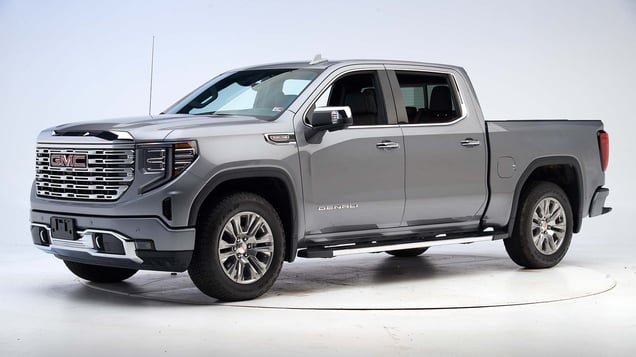
2026 GMC Sierra 1500
large pickup / Crew cab pickup
Small overlap front
The small overlap front evaluation consists of a driver-side and a passenger-side component. If the results of the two evaluations differ, then the combined small overlap rating is equal to the lower rating.
Driver-side
Tested vehicle: 2019 Chevrolet Silverado 1500 LT Crew Cab 2wd
Rating applies to 2019-26 models
The Chevrolet Silverado 1500 and GMC Sierra 1500 Crew Cab were redesigned for the 2019 model year.
| Evaluation criteria | Rating |
|---|---|
| Overall driver-side evaluation | |
| Structure and safety cage | |
| Driver injury measures | |
| Head/neck | |
| Chest | |
| Hip/thigh | |
| Lower leg/foot | |
| Driver restraints and dummy kinematics | |
Technical measurements for this test
Measures of occupant compartment intrusion on driver side
| Evaluation criteria | Measurement |
|---|---|
| Test ID | CEN1813 |
| Lower occupant compartment | |
| Lower hinge pillar max (cm) | 7 |
| Footrest (cm) | 22 |
| Left toepan (cm) | 28 |
| Brake pedal (cm) | 11 |
| Parking brake (cm) | |
| Rocker panel lateral average (cm) | 3 |
| Upper occupant compartment | |
| Steering column | 4 |
| Upper hinge pillar max (cm) | 9 |
| Upper dash (cm) | 9 |
| Lower instrument panel (cm) | 9 |
Driver injury measures
| Evaluation criteria | Measurement |
|---|---|
| Test ID | CEN1813 |
| Head | |
| HIC-15 | 110 |
| Peak gs at hard contact | no contact |
| Neck | |
| Tension (kN) | 1.0 |
| Extension bending moment (Nm) | 11 |
| Maximum Nij | 0.19 |
| Chest maximum compression (mm) | 23 |
| Femur (kN) | |
| Left | 0.7 |
| Right | 0.9 |
| Knee displacement (mm) | |
| Left | 3 |
| Right | 2 |
| Knee-thigh-hip injury risk (%) | |
| Left | 0 |
| Right | 0 |
| Maximum tibia index | |
| Left | 0.36 |
| Right | 0.99 |
| Tibia axial force (kN) | |
| Left | 3.7 |
| Right | 2.6 |
| Foot acceleration (g) | |
| Left | 151 |
| Right | 75 |
Passenger-side
Tested vehicle: 2019 Chevrolet Silverado 1500 LT Crew Cab 2wd
Rating applies to 2019-26 models
The Chevrolet Silverado 1500 and GMC Sierra 1500 Crew Cab was redesigned for the 2019 model year.
| Evaluation criteria | Rating |
|---|---|
| Overall passenger-side evaluation | |
| Structure and safety cage | |
| Passenger injury measures | |
| Head/neck | |
| Chest | |
| Hip/thigh | |
| Lower leg/foot | |
| Passenger restraints and dummy kinematics | |
| Driver injury measures | |
| Head/neck | |
| Chest | |
| Hip/thigh | |
| Lower leg/foot | |
| Driver restraints and dummy kinematics | |
Technical measurements for this test
Measures of occupant compartment intrusion on passenger side
| Evaluation criteria | Measurement |
|---|---|
| Test ID | CEP1825 |
| Lower occupant compartment | |
| Lower hinge pillar max (cm) | 14 |
| Footrest (cm) | 26 |
| Right toepan (cm) | 30 |
| Center toepan (cm) | 27 |
| Rocker panel lateral average (cm) | 1 |
| Upper occupant compartment | |
| Center dash (cm) | 16 |
| Upper hinge pillar max (cm) | 20 |
| Upper dash (cm) | 18 |
| Right lower dash (cm) | 17 |
Passenger injury measures
| Evaluation criteria | Measurement |
|---|---|
| Test ID | CEP1825 |
| Head | |
| HIC-15 | 123 |
| Peak gs at hard contact | no contact |
| Neck | |
| Tension (kN) | 1.0 |
| Extension bending moment (Nm) | 18 |
| Maximum Nij | 0.24 |
| Chest maximum compression (mm) | 19 |
| Femur (kN) | |
| Left | 3.8 |
| Right | 3.5 |
| Knee displacement (mm) | |
| Left | 10 |
| Right | 8 |
| Knee-thigh-hip injury risk (%) | |
| Left | 1 |
| Right | 1 |
| Maximum tibia index | |
| Left | 0.81 |
| Right | 1.10 |
| Tibia axial force (kN) | |
| Left | 1.7 |
| Right | 2.9 |
| Foot acceleration (g) | |
| Left | 116 |
| Right | 93 |
Driver injury measures
| Evaluation criteria | Measurement |
|---|---|
| Test ID | CEP1825 |
| Head | |
| HIC-15 | 36 |
| Peak gs at hard contact | no contact |
| Neck | |
| Tension (kN) | 0.6 |
| Extension bending moment (Nm) | 10 |
| Maximum Nij | 0.14 |
| Chest maximum compression (mm) | 20 |
| Femur (kN) | |
| Left | 0.0 |
| Right | 0.0 |
| Knee displacement (mm) | |
| Left | 0 |
| Right | 0 |
| Knee-thigh-hip injury risk (%) | |
| Left | 0 |
| Right | 0 |
| Maximum tibia index | |
| Left | 0.29 |
| Right | 0.16 |
| Tibia axial force (kN) | |
| Left | 0.4 |
| Right | 0.2 |
| Foot acceleration (g) | |
| Left | 40 |
| Right | 34 |
Side: updated test
Tested vehicle: 2023 Chevrolet Silverado 1500 LT Crew Cab 4wd
Rating applies to 2019-26 models
The Chevrolet Silverado 1500 and GMC Sierra 1500 Crew Cab were redesigned for the 2019 model year. Two tests of the Silverado were conducted because the rear passenger data acquisition system failed during the first test. Driver dummy injuries, rear dummy restraints and kinematics and structural ratings are based on both tests. The rear dummy injury values are based only on the second test.
| Evaluation criteria | Rating |
|---|---|
| Overall evaluation | |
| Structure and safety cage | |
| Driver injury measures | |
| Head/neck | |
| Torso | |
| Pelvis | |
| Driver head protection | |
| Rear passenger injury measures | |
| Head/neck | |
| Torso | |
| Pelvis | |
| Rear passenger head protection | |
Technical measurements for this test
Measures of occupant compartment intrusion on driver side
| Evaluation criteria | Measurement | |
|---|---|---|
| Test ID | CES2311 | CES2305 |
| B-pillar to longitudinal centerline of driver's seat (cm) | -23.0 | -21.5 |
| Negative numbers indicate the amount by which the crush stopped short of the seat centerline. | ||
Driver injury measures
| Evaluation criteria | Measurement | |
|---|---|---|
| Test ID | CES2311 | CES2305 |
| Head | ||
| HIC-15 | 49 | 91 |
| Peak gs at hard contact | no contact | no contact |
| Neck | ||
| Tension (kN) | 0.5 | 0.8 |
| Compression (kN) | 0.3 | 0.4 |
| Shoulder | ||
| Lateral deflection (mm) | 13 | 13 |
| Lateral force (kN) | 0.6 | 0.7 |
| Torso | ||
| Maximum deflection (mm) | 18 | 19 |
| Average deflection (mm) | 16 | 17 |
| Maximum deflection rate (m/s) | 1.42 | 1.71 |
| Maximum viscous criterion (m/s) | 0.10 | 0.12 |
| Pelvis | ||
| Combined force (kN) | 2.5 | 2.5 |
Passenger injury measures
| Evaluation criteria | Measurement |
|---|---|
| Test ID | CES2311 |
| Head | |
| HIC-15 | 158 |
| Peak gs at hard contact | no contact |
| Neck | |
| Tension (kN) | 0.8 |
| Compression (kN) | 0.5 |
| Shoulder | |
| Lateral deflection (mm) | 42 |
| Lateral force (kN) | 2.0 |
| Torso | |
| Maximum deflection (mm) | 54 |
| Average deflection (mm) | 39 |
| Maximum deflection rate (m/s) | 5.27 |
| Maximum viscous criterion (m/s) | 0.86 |
| Pelvis | |
| Combined force (kN) | 1.1 |
Front crash prevention: pedestrian
Child seat anchors
Rating applies to 2019-26 models
| Evaluation criteria | Rating |
|---|---|
| Overall evaluation | |
| Vehicle trim | Denali |
| Seat type | leather |
This vehicle has 2 rear seating positions with complete child seat attachment (LATCH) hardware. It has 1 additional seating position with a tether anchor only.
| Rating icon | Rating |
|---|---|
| G | Good |
| A | Acceptable |
| M | Marginal |
| P | Poor |
| Seating positions that rely on borrowed lower anchors or have only a tether anchor available are not rated. | |
thether anchor symbol | Tether anchor |
lower anchor symbol | Lower anchors |
| Lower anchor(s) can be borrowed from adjacent positions(s) | |
| No hardware available |
Details by seating position
| Position | Rating |
|---|---|
| 1 | |
| Tether anchor | |
| hard-to-find location | |
| other hardware could be confused for anchor | |
| Lower anchors | |
| too deep in seat | |
| not too much force needed to attach | |
| easy to maneuver around anchors | |
| 2 | |
| Tether anchor | |
| hard-to-find location | |
| other hardware could be confused for anchor | |
| Lower anchors | |
| none available | |
| 3 | |
| Tether anchor | |
| hard-to-find location | |
| other hardware could be confused for anchor | |
| Lower anchors | |
| too deep in seat | |
| not too much force needed to attach | |
| easy to maneuver around anchors |
Technical measurements for this test
Seat position 21
| Lower anchor A | |
|---|---|
| Open access rated | No |
| Depth (cm) | 2-4 |
| Force (lbs) | 24 |
| Clearance angle (degrees) | 82 |
| Lower anchor B | |
| Open access rated | No |
| Depth (cm) | 2-4 |
| Force (lbs) | 28 |
| Clearance angle (degrees) | 80 |
| Tether anchor | |
| Location | Other seating position |
| Confusing hardware present | Yes |
| Has contrasting label within 3 inches of tether anchor |
No |
| Tether anchors can be accessed while seatback is properly positioned for use of LATCH |
Not measured |
Seat position 22
| Lower anchor A | |
|---|---|
| No lower latch for this seat position | |
| Lower anchor B | |
| No lower latch for this seat position | |
| Tether anchor | |
| Location | Other seating position |
| Confusing hardware present | Yes |
| Has contrasting label within 3 inches of tether anchor |
No |
| Tether anchors can be accessed while seatback is properly positioned for use of LATCH |
Not measured |
Seat position 23
| Lower anchor A | |
|---|---|
| Open access rated | No |
| Depth (cm) | 2-4 |
| Force (lbs) | 29 |
| Clearance angle (degrees) | 82 |
| Lower anchor B | |
| Open access rated | No |
| Depth (cm) | 2-4 |
| Force (lbs) | 27 |
| Clearance angle (degrees) | 68 |
| Tether anchor | |
| Location | Other seating position |
| Confusing hardware present | Yes |
| Has contrasting label within 3 inches of tether anchor |
No |
| Tether anchors can be accessed while seatback is properly positioned for use of LATCH |
Not measured |